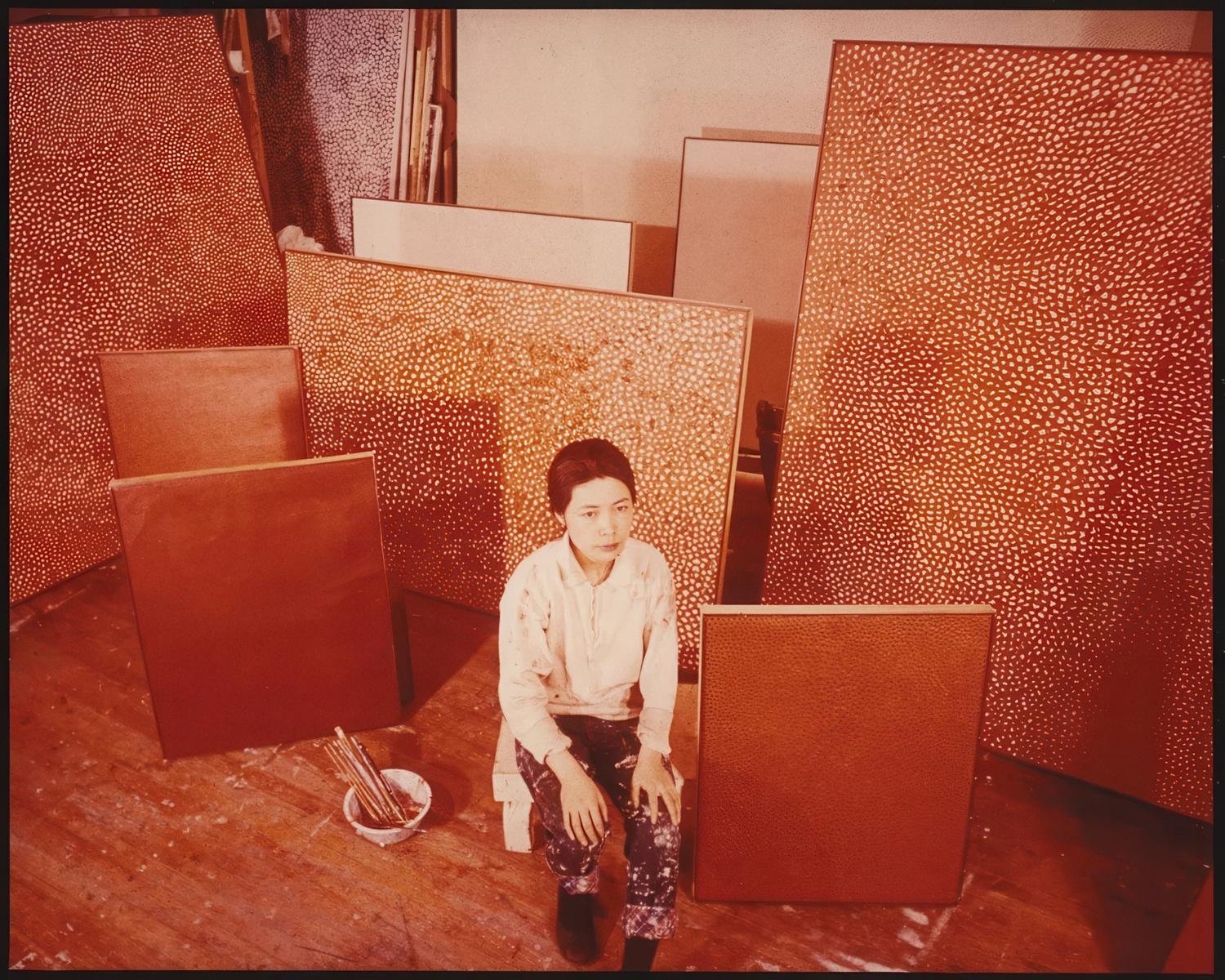
Pain is shaped like a polka dot
By Veronica Bonato
Listen
“When I write about a frayed art that loses its edges, its margins, and blends into the uncomfortable, sad and troubled margins of the present, I also mean, deep down, this: we desperately need an art that is consciously able to merge with reality.”
Contro l’arte fighetta (Against posh art), C. Caliandro (2023)
Yayoi Kusama’s colourful polka dots are glazed with tragic sadness. Huge flowers, phallic expanses, bright colours, simple repeating shapes, and a Japanese woman who in 1957 packs her bags and runs off to America to study art. With Yayoi the mechanism is similar to the one we find in figures like Charlie Chaplin: lightness becomes a form through which pain can find expression. Her wonderland, as she liked to call it, is the therapy of a woman who managed to give shape to her pain, understand it and transform it through art.
Many would call this approach art therapy, but it is perhaps more interesting to call it empathetic art. The empathetic dimension is, etymologically, that of shared suffering. In this sense empathy becomes the game of wearing someone else’s skin, a continuous identification of one being with another. Yayoi showed it from an early age, growing up with an overly strict mother and an unfaithful father she was made to spy on.
Thinking back to her childhood and her first encounter with art, Yayoi remembered lying on the floor at home, hurriedly filling whole sheets with polka dots before her mother could reach her and tear them up. Of that time she said: “There was a blinding light, I was dazzled by the flowers. I looked around and the image persisted: I felt I was sinking, as if those flowers wanted to annihilate me.”
Yayoi was born on 22 March 1929, an Aries. Passionate and impassioned, she began to show the first signs of hallucination at just ten. It is unclear whether her parents were fully aware of it or simply thought her too strange. Suffering from obsessive-compulsive disorder, she described seeing enormous, terrifying flowers spreading from the tablecloths over everything, even her own body; a year later her grandfather’s pumpkins began talking to her.
Many might think that mental disorders exert a strong power over art, that a predisposition to let go completely, without filters, helps one surrender entirely to oneself and reach the level of personal deconstruction that leads to the work. But not for Yayoi: she is mistress of her time. She arrived in New York in the years of the emerging Fluxus, of performance, of free love. With the promise of attending a finishing school - where she never set foot - and studying art alongside it, Yayoi began to give a face to all her voices.
In those years, the gentrification that has since taken hold of the art world was perhaps impossible to imagine: Japan was making a decisive contribution to spreading an art rooted in the social dimension. It is within this tension that Yayoi moved, carrying with her an idea of art that has no need to stay in its place.
Like other women of her age and country, she belongs to a generation of Japanese women destined to change art history forever. But before free love and the rise of performance art came the years shaped by the end of the Second World War. Japan, defeated and under American occupation, went through a deep social and cultural transformation. It was in this climate that the first movements of rupture were born, driven by a sensibility we might now trace back to Junk Art: movements that opened the way to a new way of understanding art, one that left museums to enter people’s lives, far from aesthetic polish, conceptual yet at the same time deeply concrete.
Yayoi never fully embraced Fluxus; her conceptual closeness to it lies rather in the instinctive way she always lived and conceived of making art. She needed art as much as art needed her.
Her childhood would haunt her for most of her life: those sheets torn up by her mother became the emblem of her approach to surfaces - fervent, emphatic, extremely fast. Little by little the polka dots left the paper and covered every wall, every ceiling, even her clothes. Her output never stopped, not even in the years in the psychiatric hospital. Art was no longer just the place where Yayoi poured out what she saw, but the means by which she could make it visible to others. Empathetic art.
What is most surprising about an artist like Yayoi is precisely this pain/eccentricity paradigm: her worlds take shape from an almost primordial need to be spewed out, and they become a global symbol of freedom and imagination.
“A polka dot has the form of the sun, which is a symbol of the energy of the whole world and our living life, and also the form of the moon, which is calm… Our earth is only one polka dot among a million stars in the cosmos. Polka dots are a way to infinity.”