Grass babies, moon babies
By Maddalena Luraghi
Listen
At this year’s Venice Biennale, the Japan Pavilion only exists if it is looked after.
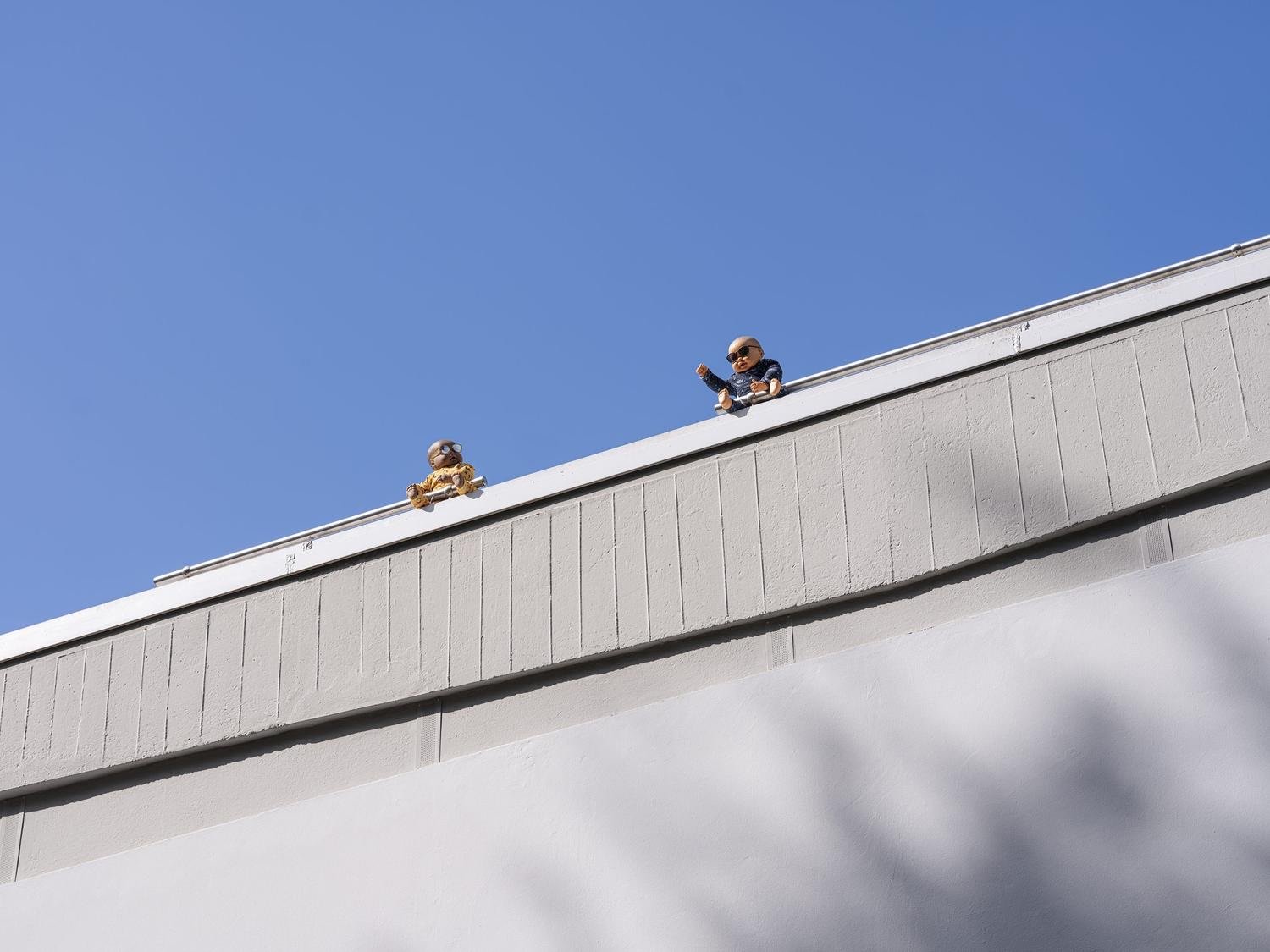
Ei Arakawa-Nash has filled the space with about two hundred dolls and given every visitor a task that sounds unprecedented in a museum: changing a nappy.
Each doll has a date of birth and a poem that unlocks with a code hidden inside the nappy. The dates weave together the biography of the artist, who became the parent of twins in 2024, and the social transformations of Japan.
Grass Babies, Moon Babies exists only as long as someone takes care of it: without the visitors’ hands, it is a room of inert objects.
There is one word in particular whose meaning splits in two in this installation.
The credit line “curated by Lisa Horikawa and Mizuki Takahashi” becomes a term that refers both to the humblest gesture of washing, feeding and caring for a body that depends on us, and to the prestige of the curator. Two acts the art world keeps at opposite ends of its scale of values, and which share, at the root, the same Latin verb: curare, to care for.
In the early 1980s Carol Gilligan brought this idea into focus by formalising the so-called ethics of care: a moral voice oriented towards responsibility for others and concrete bonds, rather than abstract principles and rules. A voice that dominant theories, built on male experience, had until then treated as a less mature form of morality. Care is what every life rests on and, at the same time, what no one shows.
Arakawa-Nash takes this hierarchy and turns it upside down, bringing the domestic gesture to the centre of the Biennale and handing the curatorial act over to the visitors - and with it, the power to decide whether the work lives or dies.
The idea is not new in itself. Ever since Nicolas Bourriaud, in the late 1990s, named art that happens in the relationships between people rather than in objects relational aesthetics, we have known that a work can also consist of what is created between its viewers. Here, though, the relationship is not a shared meal or a conversation: it is caregiving.
Visitors are not asked to take part, but to take on a responsibility, however small and openly fake.
And this is where the frame - explicitly queer and diasporic, that of a Japanese American artist living in Los Angeles - stops being a mere biographical detail. Entrusting a plastic child to strangers means asserting that family is a matter not of blood but of gestures. We become the parents of something at the precise moment we take care of it. It is a definition of kinship that asks permission neither of biology nor of institutions.
It is worth remembering that cura, in Italian, also means therapy, remedy - and this pavilion offers none. Changing a doll’s nappy heals nothing. But perhaps art has never been a cure in the medical sense; it is more of an exercise, a protected place where we can rehearse, on a tiny scale and without consequences, the gesture of bending towards something that depends on us. Not the healing of the world, but its training.
There is an ancient fable about Cura, Care, which Heidegger takes up in Being and Time: it imagined that she, care made person, shaped the first human from clay and was allowed to keep him with her for as long as he lived. As if to say that being alive has always meant being held by something. And that we never entirely stop answering for someone.
For a few minutes, with that bundle in your arms, you feel it: the instinct to hold, the responsibility, however fake. Then you hand the doll back at the exit and it is all forgotten: life goes back to flowing with nothing to hold at your side. A relief, of course. But a free side is also an empty side, and perhaps this is exactly what the exhibition gives you in exchange for the doll: the suspicion that existing without any weight to carry resembles not lightness so much as a lack.
Perhaps this is what is left for art to do today: not to arrange beautiful things in a room, but to give us back, even just for the length of an exhibition, a sense of what it means to have something to keep safe.