Film ·
No one will hear our screams. Sirāt and the symbolic value of Tekno
By Simone Resigotti
Listen
There is a bridge called Sirāt that connects heaven and hell. Those who cross it are warned that its passage is narrower than a hair and sharper than a sword.
These are the words that open Sirāt, the film directed by Óliver Laxe, winner of the Jury Prize at Cannes and nominated for the Oscar for Best International Feature. It is a hypnotic work, built on sounds echoing across the Moroccan desert. A father and son travel through illegal raves chasing a hope that already tastes of loss: finding the eldest daughter, who has disappeared without a trace.
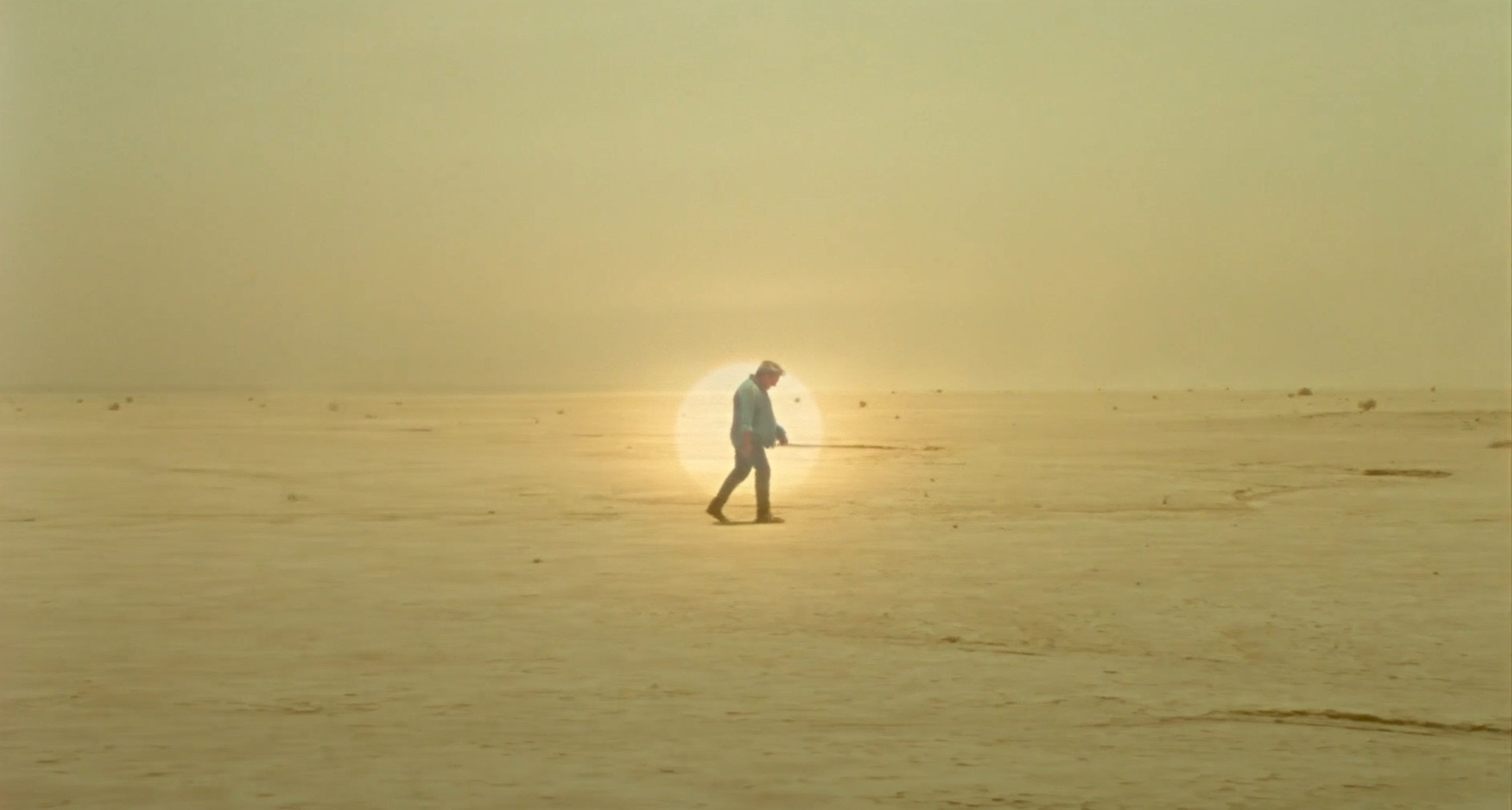
The characters move through a landscape that seems to lie just a few steps from the edge of the world. A suspended, fragile territory. Sirāt, precisely.
Around them looms a war that seems to involve the entire planet. But it is never shown openly. We sense it from the military evictions, the weapons, the metallic voices on the car radios. It is a constant presence, like background noise that never stops pulsing. Sharing the journey with father and son is an unlikely group of ravers: tired bodies, marked by time. Figures who seem to have survived something that is never named but keeps bearing down on them.
It is a work about the present, and it speaks of it without rhetoric, but with a lucid, undeniable sense of catastrophe. That thin line called Sirāt is the same one our generation walks in precarious balance, through the streets of a world that can no longer bear our climatic, social and political impact. A world already past the point of no return. Wars, genocides, state massacres and violent repression happen a few hours’ flight from us. And yet we keep going, as if everything could not snap at any moment.
The film forces us to look at this fragility. It stuns us and drags us along with a dark, pounding, deep tekno soundtrack by the producer Kangding Ray. Basslines vibrating in your chest and sound systems spitting decibels for days, relentlessly. It is the tekno of raves, the kind that grants no pauses and no comfort.
But in Sirāt, tekno is not just a soundtrack. It is a symbol.
It is a genre built on repetition, on insistence, on taking sameness to the extreme. Like the sounds of the industrial world we are immersed in. Tekno amplifies the constant background noise that lives in industrial zones, computer keyboards, assembly lines, the binary logic of ones and zeros. The synths do nothing but capture those constant hums and turn them into melodic lines that keep their mechanics.
Seen this way, tekno becomes the heart of a larger ritual, made of hours of electronic sound to be heard with your eyes closed, losing all sense of time and space. Sweaty, intoxicated and tired. Bodies that stop having boundaries and keep going even when the strength is gone. And in the end you free yourself by dancing to exhaustion, shaking the filth off you.
It is a cathartic gesture: vibrating to a pounding kick, repeating movements until they are no longer frightening. It is like taking the terror of the world and repeating it so many times that it loses its meaning. Like when a word, repeated over and over, stops making sense.
Sirāt shows us all this in the fragility of a world where everything obeys the rule spoken by one of the characters: “you never know if it will be the last time it works”. A rule that applies to our lives too. Lives that wind through the gaps of an unstable, indifferent reality in which our voice always goes unheard. Like scattered sounds in the desert. Like screams drowned out by music, that no one will hear.