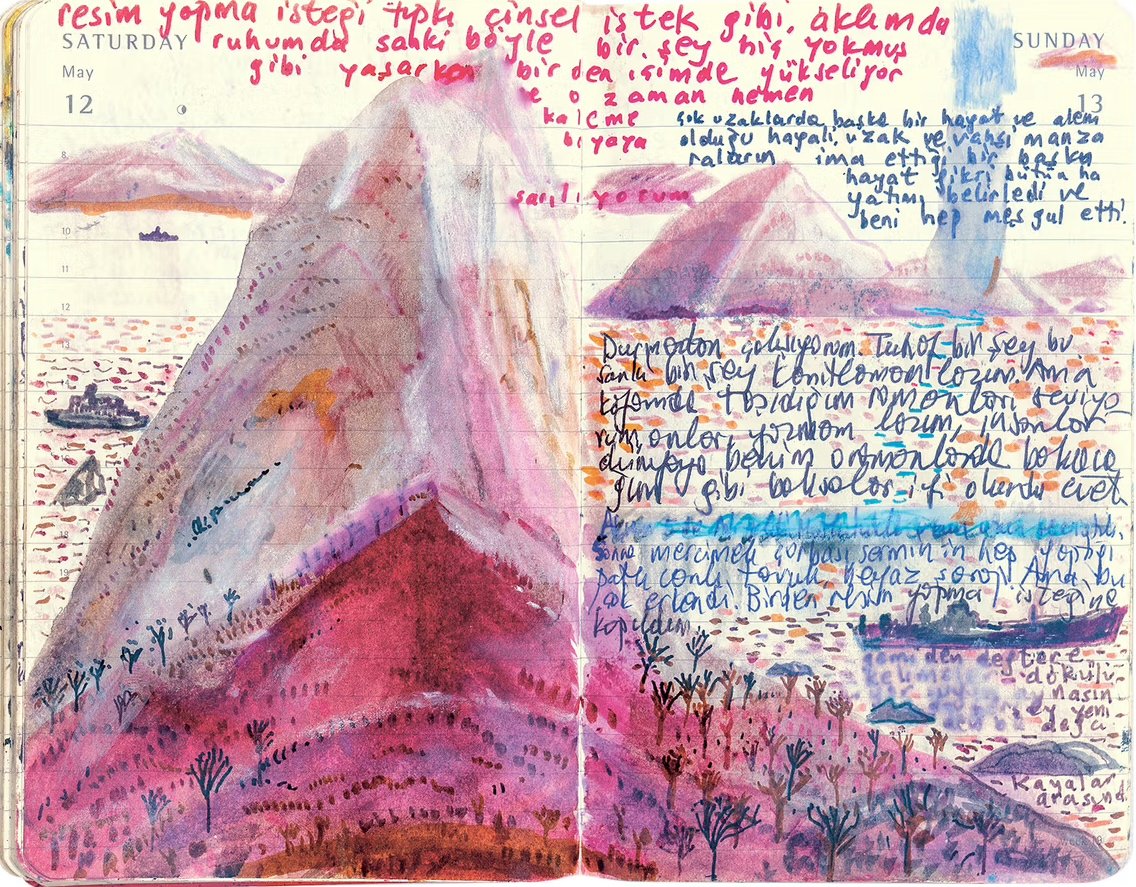
Memories of Distant Mountains and why we should keep a notebook
By Simone Resigotti
Listen
There is a book by Orhan Pamuk that is not quite a book. Memories of Distant Mountains (2023; Einaudi in Italy) is a selection from the notebooks the Turkish writer and Nobel laureate in literature filled over more than a decade of his life. Free from the burden of giving the text a final form, Pamuk allows himself to be incomplete, offering glimpses of ideas, doubts and attempts before they become literature.
Leafing through Memories of Distant Mountains, in fact, you get to witness the stage of creation in which thought has not yet taken its final shape. It is an accumulation of traces arranged on the white of the page according to the only possible order: the author’s sensibility. And it is from these exercises in freedom that a wider reflection arises on why it matters to always carry a notebook.
Recording the events of a day or your impressions on paper is a gesture that trains presence and, with it, the ability to turn everyday life into a series of details worth keeping. You give shape to your thoughts, letting them exist in a more understandable space.
In a world ruled by notifications and constant distractions, keeping a notebook means choosing a particular kind of attention, one that lets you capture reality before it scatters.
Writing by hand, moreover, deeply engages the brain and the way we think. Unlike a keyboard, where the same gesture repeats for every key, handwriting keeps a unique trace of the individual. Every letter requires a different movement, a specific choice of rhythm and pressure. This process involves several areas of the brain that strengthen memory, understanding and the ability to learn. That is why carrying a notebook and pen is not just a romantic habit but, above all, a way of thinking better.
Another essential aspect of handwriting is that you cannot instantly erase what you have put on the page. This forces you to select and rework information, training your ability to summarise. But the notebook is, above all, a tool for stopping time. Not by freezing it, but by turning the present into material for the future. So that we can keep our perceptions and look at them again with fresh eyes, asking ourselves who we were and who we are becoming.
With Memories of Distant Mountains, Pamuk teaches us to slow down so that ideas can settle into the marks of our handwriting, and at the same time suggests a very simple practice to everyone: always carry pen and paper, write by hand, note down what you see, what you think and what you are afraid of forgetting, so as to slowly build a memory of your own way of looking at the world.