Art ·
The aesthetics of anonymity
By Elena Tonon
Listen
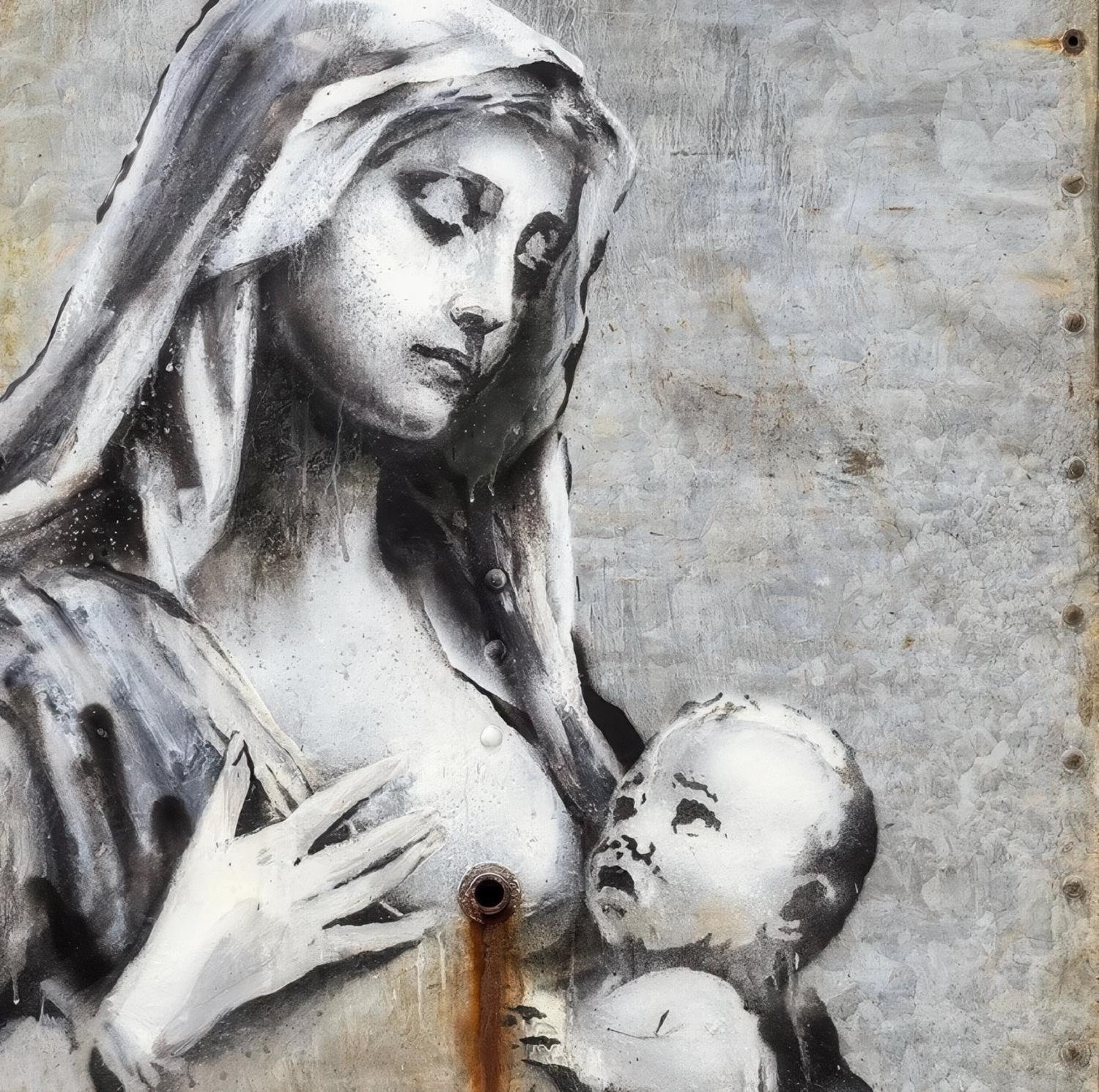
A few weeks ago, Reuters announced in an investigation the true identity of Banksy.
Although the artist’s anonymity was tied to the wish to express himself without fear of censorship or political persecution, and to the desire to protect his privacy, Reuters decided to ignore both in order to honour its professional ethics and satisfy public curiosity.
Revealing the identity of one of the best-known, most followed artists of our time leads to a question that seems trivial but has rather many-sided answers: how much does it affect our reading of Banksy’s work to know that the author is called Walter White and is an oncological chemist, or Mildred Ratched and is a repressed nurse? In other words, how much do we need to know an artist’s identity to judge the power and intrinsic value of their work?
The aesthetics of anonymity protects the author, but it is also a way of freeing the work from self-centred vanity, focusing attention on the product rather than the producer.
Knowing an author’s identity helps us put their artistic output in context and guides us through its more cryptic, symbolic details. At the same time, an artist’s controversies and pettiness can be exploited to offer a reading that follows the sensibility of our own time more than the original intent, binding the work to moralistic principles that distract and condition - and that end up saying more about how we want to be seen by others than about the work itself. What is more, in a work of art an author often deposits exactly what they hope to become, a slightly better version of themselves they would like to strive towards but inevitably cannot reach because of the tensions holding them back; or, on the contrary, they pour into the work what they fear being, reaching a kind of exorcism that makes it all more bearable.
Today, moreover, we might even argue that the author-work relationship is collapsing under its own paroxysm, as the intervention and interference of artificial intelligence make knowing the author’s name almost anachronistic, or at least secondary. But that would open another discussion.
As for Banksy’s case specifically, there is another aspect to consider. An artist can mask their identity, or hide it completely. So while figures such as Liberato, Miss Keta and TonyPitony - to cite a few examples closer to home in Italy - use the mask as an aesthetic device that helps solidify a brand and slot perfectly into the logic of the market, Banksy’s anonymity is a political subtraction. On one side, the wish to appear without being; on the other, the wish to be without appearing.
In his essay The Death of the Author, Roland Barthes argues that the very concept of the author - in his case the literary author - is a character produced by modern Western society, which exalts the prestige of the individual, tyrannically centred on their own story, tastes and passions. To give a text, in the broad sense, an Author is to impose a fixed stopping point on it, to close it in a final meaning. But a text is made of writings and cultures in dialogue with each other, whose ultimate meeting place is the reader - or viewer: the one who holds together in a single field all the traces a piece of writing is made of.
Perhaps, then, not knowing absolutely everything about whoever created the work frees us, first of all, from superstructures that, while enriching our knowledge, also stop us from being swept away by the most primal meaning of what we see or hear. A way of preserving the purity of the work, the final longing to let it speak without exposing itself.