Film ·
Princess Mononoke, horror at the human species
By Marcello Guardo
Listen
I am not exactly proud of the reason I have watched Princess Mononoke so many times, but honestly I have never blamed myself for it either. Of course there are a thousand other reasons, but the one I mean has worked its way deep into my imagination: the scenes in which the forest animals hurl themselves at their rightful enemy, the human being, always give me a thrill of pleasure.
Knowing the director’s views, I always thought Hayao Miyazaki felt the same while drawing the wolves and boars charging to defend nature from humans. But watching Princess Mononoke again today, back in cinemas between 4 and 10 June, changed something in how I understand it - perhaps for the better.
The story is set in Japan between the fourteenth and sixteenth centuries and follows a conflict between the people of Iron Town, led by the shrewd Lady Eboshi, and the spirits of the forest, beasts acting in the name of a deity called Shishigami, the Forest Spirit. The protagonists are two young people, Ashitaka and San. Ashitaka is a stranger to the conflict, forced to discover the origin of a demon that has cursed him and condemned him to death; San was raised by wolves and fights alongside them to defend the forest from Lady Eboshi. The bond that grows between them is constantly cracked by San’s hatred for humans, her own species. Until yesterday this was enough to break my heart; today I can no longer ignore everything else.
It is naive to think that Hayao Miyazaki, known for his long active involvement in the environmental cause in his country, meant to reduce the meaning of his most explicit film on the coexistence of humans and nature to a resigned misanthropy. In an interview with Margaret Talbot of the New Yorker, the director said that growing up in Japan in the Shōwa period (1926-1989) was very hard for him, because the whole era was marked by massive destruction of nature, of mountains and rivers, in the name of economic progress. Miyazaki was born in 1941 and lived between Utsunomiya and Tokyo, witnessing in his youth the so-called “Japanese economic miracle”, the country’s sudden growth driven by its entry into international markets and the development of industry: steel, motor vehicles, electronics. In the 1950s and ’60s the Japanese population grew, work took on enormous importance and by the early ’70s the face of the cities had changed sharply too. In big economic hubs like Tokyo, Yokohama and Nagoya, apartments got smaller and smaller, noise and air pollution rose and serious respiratory illnesses spread through the population. The culmination of this slide was the ecological disaster caused by the Chisso Corporation, whose wastewater caused dangerous mercury poisoning in the south of the country.
It is not hard to find in Studio Ghibli films references to the present Miya-san lived through first-hand. The futures painted in his works are often dystopian, and he himself has made some not entirely joking statements about how “Tokyo will be submerged by the ocean and the NTV tower will become an island, when the human population collapses and there are no more skyscrapers”.
So what is wrong with thinking that San, the spirit girl, speaks for Miyazaki? Why can’t I hate my species too and side, like her, with nature?
The opening sequence of Princess Mononoke already hides a clue to the complexity the story brings to light. Ashitaka is the prince of an exiled people, the Emishi, who live on the margins of the empire. To save his village, Ashitaka kills a boar, and his right arm catches its curse. The boar, wounded in battle by a bullet, had turned into a demon full of hatred and thirsting for revenge. Humans had inflicted unspeakable physical suffering on it, exterminated its people and devastated the forest it protected. This dramatic event is recounted by the very person responsible for the massacre, Lady Eboshi, with the smile of someone who has defeated an enemy in battle. It is a war, and it must be fought, as if circumstances had made enemies of humans and nature. The survival of one seems to coincide with the destruction of the other, and vice versa.
And yet the boar killed by Ashitaka, with its last words, warns the Emishi: “you will feel my hatred and suffer my torments”. Humans and animals are equally threatened. But by whom?
To understand who Lady Eboshi really is - the antagonist I always took to be “the villain” - let us explore Iron Town with Ashitaka: looking at the humanity that lives there, we immediately understand that this is not a barbaric, ugly, wicked people subjugated to a tyrant, as happens for instance in The Lord of the Rings (orcs, trolls, Nazgûl, a whole catalogue of evil, soulless creatures). The society Lady Eboshi runs is virtuous, based on work, personal freedom, women’s emancipation and support for the weakest. Eboshi herself has made a group of lepers her closest collaborators. It is a model of humanity that works and leaves no one behind, but it depends on natural resources. Without iron it would fall to rival clans and to the Emperor, who offers his protection only in exchange for heavy tributes.
San and the spirits fighting for the forest shut humans out of nature as a danger to plants and animals, which live together in harmony. Miyazaki, instead, lets Ashitaka grasp the true face of this conflict: it is a civil war.
This is perhaps the most important step towards understanding the complexity of Princess Mononoke: all of creation fights first of all to survive, and in portraying Iron Town Miyazaki makes a point of including human beings in this principle. Try to imagine what it cost a lifelong environmentalist, a fierce critic of energy-hungry capitalism, to engage with this logic and give dignity to a human community ready to destroy an entire forest and every animal in it for what is, in effect, a large ironworks.
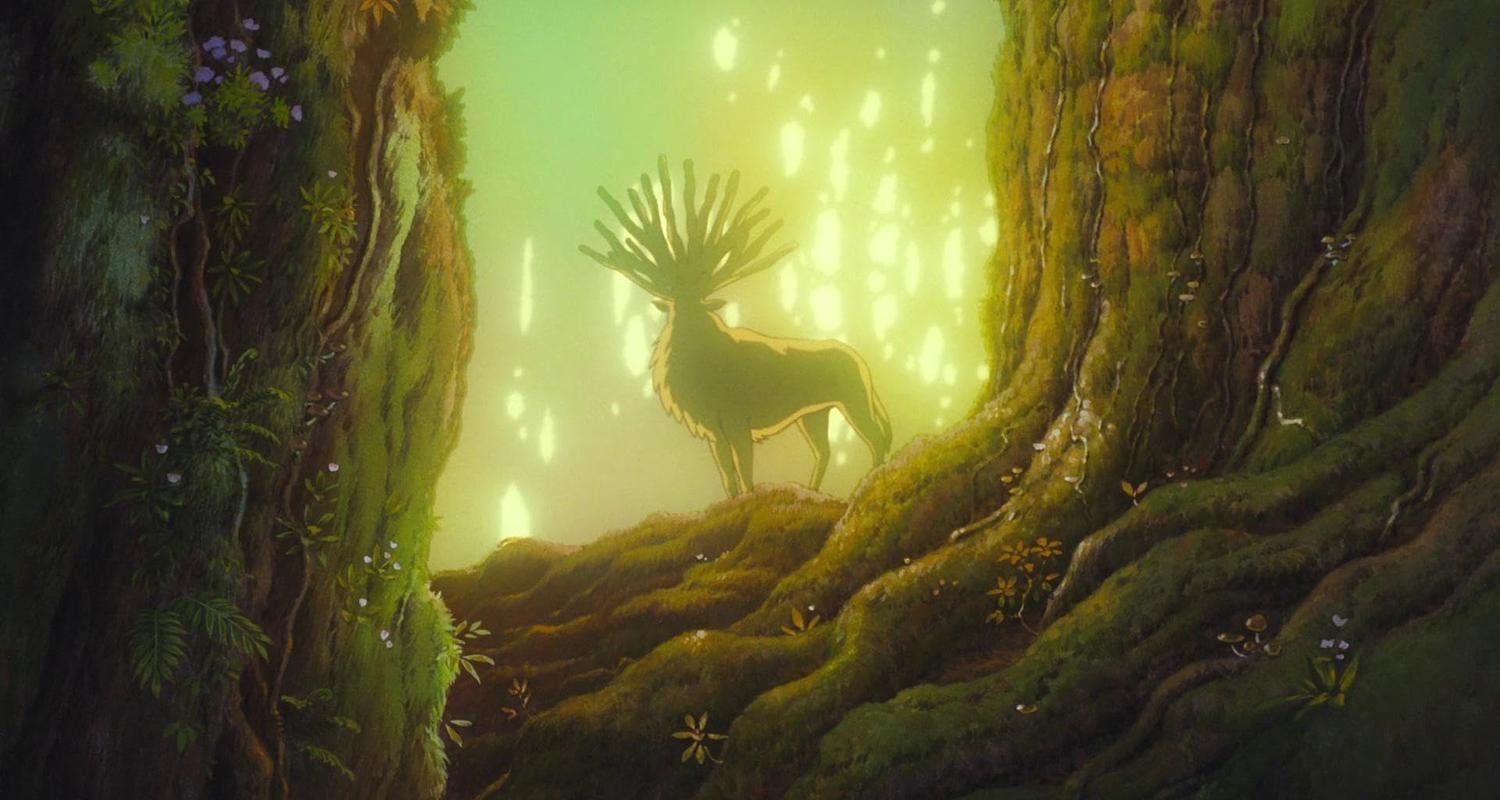
As further proof of the director’s work of inclusion towards humanity, it is worth mentioning the entity that soon becomes the heart of the story: the Forest Spirit, the most influential and mysterious of the spirits that protect the balance of nature. It is mute and elusive, takes no part in the conflict, appears only rarely and with a rather peculiar appearance on which we should pause; its body is a deer’s and, where its hooves touch the ground, the earth fills with shoots that instantly die and return to soil. But what most sets it apart from an ordinary deer is its face: it has a human face. The Forest Spirit contains within itself the animal, the plant and, evidently, the human.
Humans and nature, then, are not enemies but parts of the same system, fighting each other because of a curse that comes from far away. Miyazaki shifts our attention away from the war itself and points to what really causes all the pain and hatred clouding the hearts of Lady Eboshi and San.
If the conflict between humans and the forest springs from a kind of autoimmune disease, turning parts of the same body against each other, what is the source of this illness? To find out we must focus on an invisible character, mentioned now and then over the course of the story, who never appears in person: the Emperor.
What puts the most pressure on the two communities comes straight from the Emperor’s will. The greatest danger to the forest comes from Jigo, an imperial emissary tasked with beheading the Forest Spirit: according to legend, its head grants eternal life to whoever possesses it, and the Emperor wants to test the rumour. Lady Eboshi, for her part, worries that he will withdraw his support from Iron Town, and at the same time fears he wants to take control of it, robbing her people of their freedom. During the final battle with the boars, the Emperor provides Lady Eboshi with mercenary troops, but their methods are brutal, to the point of repeatedly endangering the lives of Iron Town’s women and men.
And so the words of the boar demon in the opening sequence come back: “you will feel my hatred and suffer my torments”. The evil born of humiliation and annihilation comes neither from humans nor from the forest spirits, but from an invisible force that crushes both humans and animals under the aegis of a violent, inhuman power.
If we brought the scenario of Princess Mononoke into the real world, we would find ourselves, today more than ever, in the middle of a civil war. Humans and forest are in conflict and, once we take the villain’s medal off Lady Eboshi’s neck, it is easy to feel lost as chainsaws devastate woods, plastic pollutes the seas and peoples grow ever poorer and hungrier.
Perhaps it is worth asking which character in this story we identify with most, but we must do so knowing that every action we take is a move on the chessboard of a delicate diplomatic balance. Every choice can be a gunshot, and every bullet can turn an innocent into a demon.
The ultra-capitalism we live immersed in can lead us to act like Eboshi, but in an instant the news reaching us from the world fills us with outrage, and it is easy to feel hatred for those responsible for the harm, like San. Having the strength to look deeper into problems and make ourselves instruments of respect and ethics, like Ashitaka, is hard - but with a curse in our body, it is also necessary.
Princess Mononoke reminds us that our behaviour has an impact; that we can be Eboshi, San or Ashitaka every day, and that the right path is the one that rejects hatred and works actively to contain it and find solutions.
Perhaps, by treasuring these principles, I too will get past the idea of no longer having an enemy to wage war on. And if it also gives me a reason not to hate the species I belong to, that will be one more reason to watch this wonderful film again.