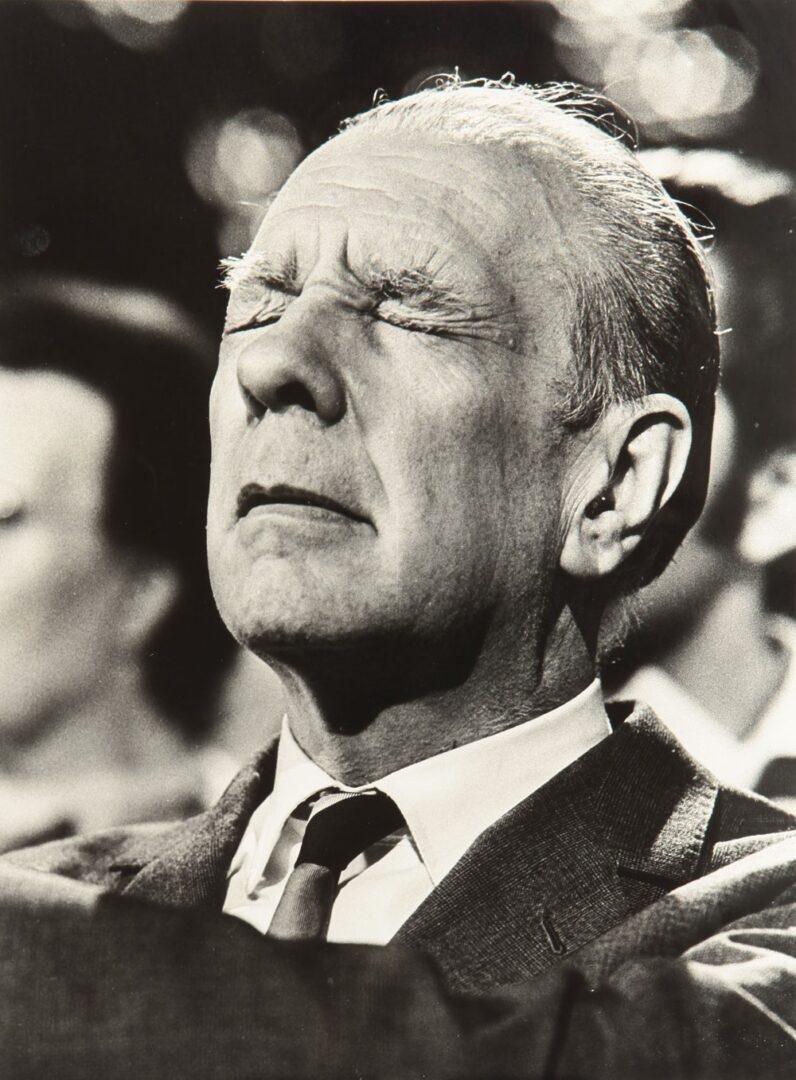
Borges and the nothingness of personality. Forty years after his death, a return to the early essay that demolished the illusion of the self.
By Simone Resigotti
Listen
Of all the paradoxes that fill Borges’s life, one of the most surprising is that he never wrote a novel. His fame rests on short stories, essays and poems: brief works in which we find labyrinths, infinite libraries, mirrors and, at times, imaginary books reviewed as if they really existed.
Descended from colonels and war heroes, Borges was a shy man in love with the courage he felt he lacked. As a child he declared that his destiny was literature and, as an adult, he became director of the National Library of Argentina, a post he took up just as he was going completely blind. He himself called this coincidence a magnificent irony of God: at the same moment he had been given all the books and the darkness that kept him from reading them.
Despite his blindness he went on writing for another thirty years, always dictating, composing and correcting everything from memory. He was perpetually a candidate for the Nobel Prize without ever winning it, and yet he changed the very idea of literature, showing that a ten-page story can hold more philosophical vertigo than an entire treatise and that fiction can question infinity, time, identity and language.
It would take a monumental study to examine Borges’s literary legacy in full. This reflection has no such vast ambition; instead it aims to shed light on the seed of his genius as an essayist, held in one of his first works: Inquisiciones (Inquisitions), published in 1925 when the author was just twenty-six. In this collection of short essays one stands out in particular, La nadería de la personalidad (The Nothingness of Personality), in which the young Borges puts forward a radical thesis: the self does not exist. There is no unified, continuous subject behind our mental states; personality is an illusion, an aggregate of perceptions and moments with no stable core holding them together. Even the recollections our memory is made of are not a lasting, tangible store, as it might seem, but rather fleeting images of our states of consciousness that sometimes resurface in confused and unpredictable ways.
In his own words: “no one can claim that the glance with which we take in a whole clear night foretells the exact number of stars it holds.”
And the high point of these few pages devoted to the nullity of the self comes when philosophical reasoning merges with a fragment of biography: saying goodbye to a friend. Borges recounts how the two of them tried to adorn that moment with an “impetuous display of opinions about the nostalgia to come”. What is extraordinary about that dialogue on the threshold of separation is Borges’s own realisation that, although his heart urged him to show his whole soul, the nothingness of personality made that final act of truth impossible.
As he writes: “It occurred to me that my life would never be justified by a full, absolute instant that contained all the others; that they would all be provisional stages, annihilating the past and turned towards the future; and that outside the sphere of the contingent, of the present, of circumstance, we were nobody.”
And yet Borges disowned this and other works of his youth. He did so essentially for reasons of style and aesthetics, because rereading them as an adult he found them pure verbal showing-off. The mature Borges had developed the opposite ideal: a clear, almost invisible prose. That is why he refused to include them in his Obras completas and prevented them from being reprinted all his life, even going so far as to buy up copies he found in second-hand bookshops in order to destroy them.
But the case of The Nothingness of Personality is special, because it is the great exception that shows how far that disavowal was stylistic rather than conceptual. Borges, in fact, never gave up the idea that one man is all men and that subjects do not persist through time. On the contrary, he held on to those same intuitions all his life, making them the backbone of his mature work and reworking them for the next sixty years, as in A New Refutation of Time, an essay in Other Inquisitions (1952), whose very title sets up an ironic dialogue with the first, disowned Inquisitions.
And it is precisely the gesture of an author disowning his younger self that becomes the practical demonstration of the thesis he had formulated as a young man: there is no single, continuous Borges answerable for both books. He writes it himself: “I am like all the others. That is my boast and my glory. It matters little whether I proclaimed it in wretched verse or in coarse prose.”
What he never disowned, on the other hand, were his poems. Not even the youngest, most reckless and daring ones. As if the realm of poetry lived in each of us at every age, and no recklessness or inexperience could taint it with banality. Perhaps the opposite is true: we spend our whole adult life, and then old age, searching more or less desperately for the same daring we had as children.
A beautiful example of that daring is the second of the Two English Poems, written in 1934 and later collected in El otro, el mismo (1964). A poem dedicated to Beatriz, the great unrequited love of his life:
I offer you lean streets, desperate sunsets,
the moon of the jagged suburbs.
I offer you the bitterness of a man
who has looked long and long at the lonely moon.
I offer you my ancestors, my dead men,
the ghosts that living men have honoured in bronze:
my father’s father killed in the frontier of Buenos Aires,
two bullets through his lungs, bearded and dead,
wrapped by his soldiers in the hide of a cow;
my mother’s grandfather – just twentyfour –
heading a charge of three hundred men in Perú,
now ghosts on vanished horses.
I offer you whatever insight my books may hold,
whatever manliness or humour my life.
I offer you the loyalty of a man
who has never been loyal.
I offer you that kernel of myself
that I have saved, somehow –
the central heart that deals not in words,
traffics not with dreams and is untouched by time,
by joy, by adversities.
I offer you the memory of a yellow rose
seen at sunset,
years before you were born.
I offer you explanations of yourself,
theories about yourself, authentic and surprising news of yourself.
I can give you my loneliness,
my darkness, the hunger of my heart;
I am trying to bribe you with uncertainty,
with danger, with defeat.