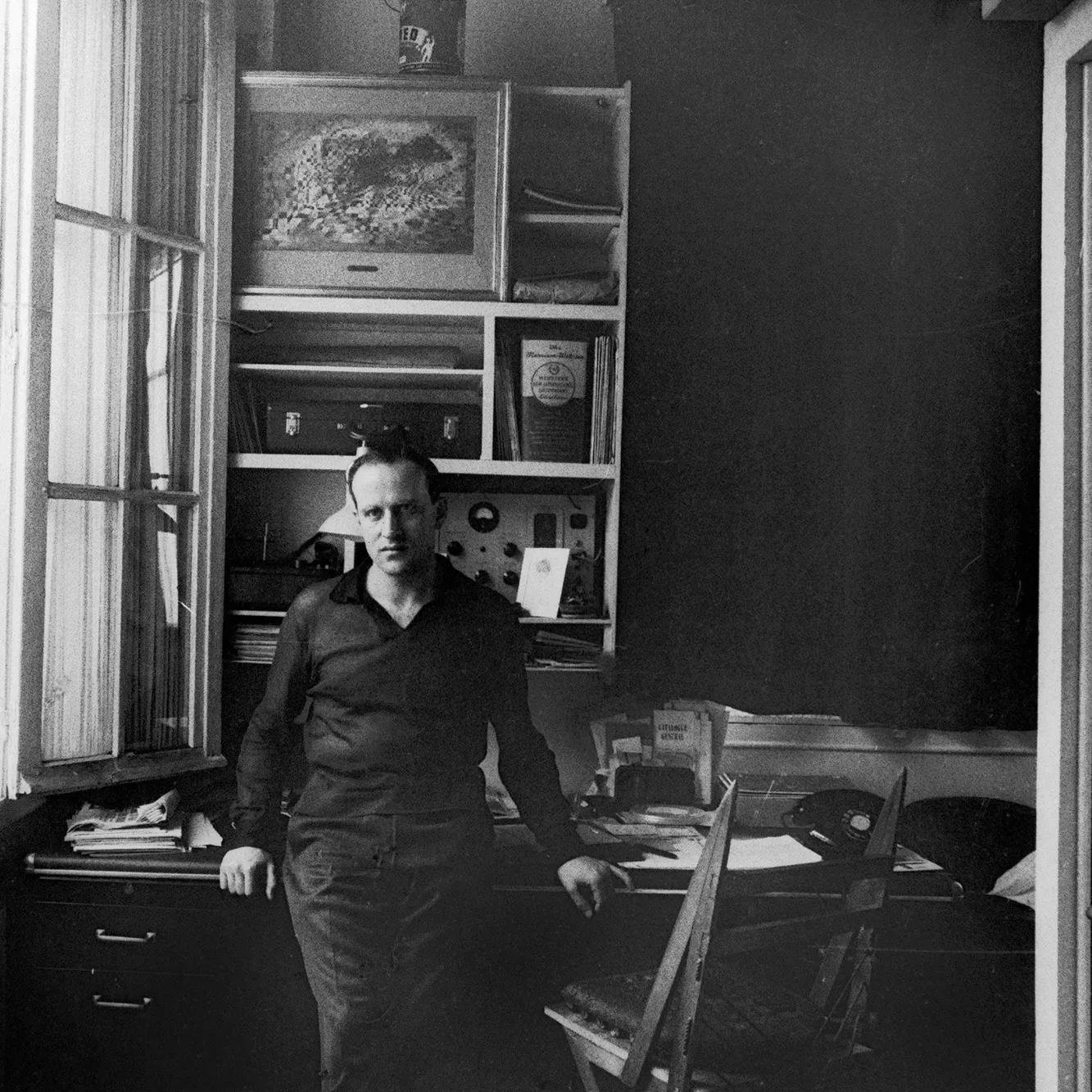
Boris Vian, a life shaped like sand slipping through your fingers
By Simone Resigotti
Listen
Boris Vian is a figure literature outside France seems to have forgotten. Yet he was a great innovator, able to invent astonishing images and open new paths, made of disturbing and tender metaphors that showed humanity the secret ways leading from the city’s underground all the way to the stars. His life was a spectacular dream, a breathless race that went beyond existence itself, driven by a visceral need to invent his own absolute freedom.
In his lifetime he was almost everything: engineer, trumpeter, novelist, journalist, translator, singer-songwriter and much more. Born in 1920 in Ville-d’Avray, at twelve he discovered he had a serious heart condition. Aware that his time was limited, he lived every moment with extraordinary creative fervour. After graduating he started working as an engineer, but soon gave it up to play the trumpet, quickly becoming a central figure of Parisian cultural life. He befriended intellectuals like Jean-Paul Sartre and Simone de Beauvoir, becoming the link between the existentialists of Saint-Germain-des-Prés and the world’s finest jazz musicians - Charlie Parker, Kenny Clarke and Duke Ellington among them - for whom Vian was both a beacon and a younger brother in the Parisian nights.
By night he played in the capital’s underground clubs, by day he wrote at a frantic pace, putting into words the soul of a unique musical era, and in 1957 he went on to become artistic director at Philips. But beyond music, it was above all Vian’s writing that represented something rare, which still asks, today, to be discovered at all costs.
His first novel, J’irai cracher sur vos tombes (I Spit on Your Graves, 1946), was born of money and a bet. Since French readers in the 1940s were hungry for American authors - hard to find because of censorship - Vian promised his publisher he would write a genuine scandalous American novel in record time. He invented Vernon Sullivan, a Black writer censored by the racist America of the day and, posing as his translator, wrote the whole book in just fifteen days. I Spit on Your Graves tells of a light-skinned Black young man who, thanks to that detail, manages to slip into bourgeois circles to avenge his brother’s murder. It is a novel of alcohol, sex, music and violence, out to punish white, rich, racist society. Although it was born almost as a game, it turns out to be a carefully calibrated book, whose brutality is deliberate and serves a heartfelt denunciation of prejudice and injustice.
But while the extremely violent stories of his alter ego Vernon Sullivan climbed the charts and racked up obscenity trials, Boris Vian was also writing surreal, poetic, exquisitely delicate stories and novels. Works that, although at first read by only a few hundred people, are the true mirror in which to discover the personality of an author always ready to be amazed by the world.
The stories later gathered in the collection Les Fourmis (The Ants, 1949) are emblematic in this sense. They stage completely absurd situations, but told in a way that makes them seem utterly real; and so we find ourselves blindly believing in bakers hunting for the sweat of people’s brows to season their bread, and in flying rooms with a view of everywhere. Vian is able to tell the mystery of an existing humanity, handing it back to the reader from an unknown angle that keeps astonishing with every line, every word.
And then there is L’écume des jours (Froth on the Daydream, also published in English as Mood Indigo, 1947), his most beautiful novel, sad and ironic at once; moving and dense with surrealism, neologisms and almost psychedelic inventions. It tells the story of Colin, a young man who empties the bathtub not by pulling the plug but by drilling through the bottom, who wears “red bat-leather sandals” and “trousers of a very deep water green”. Colin lives playing invented instruments and spending time with a great collector of the works of “Jean-Sol Partre”. He falls in love with Chloé, and the two marry among clouds that smell of coriander, in the presence of an “Archbishopper”, seventy-three musicians, fourteen Children of the Faith and two Pederasts of Honour. But after a crazy honeymoon Chloé falls ill: a water lily grows in her lungs. As the illness advances, the pain grows ever greater and the geometry of their enormous home - with bright corridors whose glass walls have suns shining behind them - grows ever more cramped. The house gradually shrinks, until it can no longer hold anything.
In his novels Boris Vian captures the dramatic side of life and the deep essence of human feelings. Having lived with death at his heels, constantly aware that he would not last long in this world, led him to shape his very existence until it resembled a work of art. The result is an exemplary witness to how you can live many lives in one… all the ones you need. Over his thirty-nine years he never stopped reinventing himself, until his death from a heart attack on 23 June 1959. An end that came, ironically, in a Paris cinema, during the first minutes of a screening of the film adapted from that very first novel, I Spit on Your Graves.