The Odyssey is not set where we think
By Laura Bertoglio
Listen
This summer we asked ourselves: what if the Odyssey were set not in Greece, but in western Sicily?
In 1897 the English scholar Samuel Butler noticed that many descriptions of Homer’s places did not match the Aegean, but found a surprising match between Trapani and the Egadi islands.
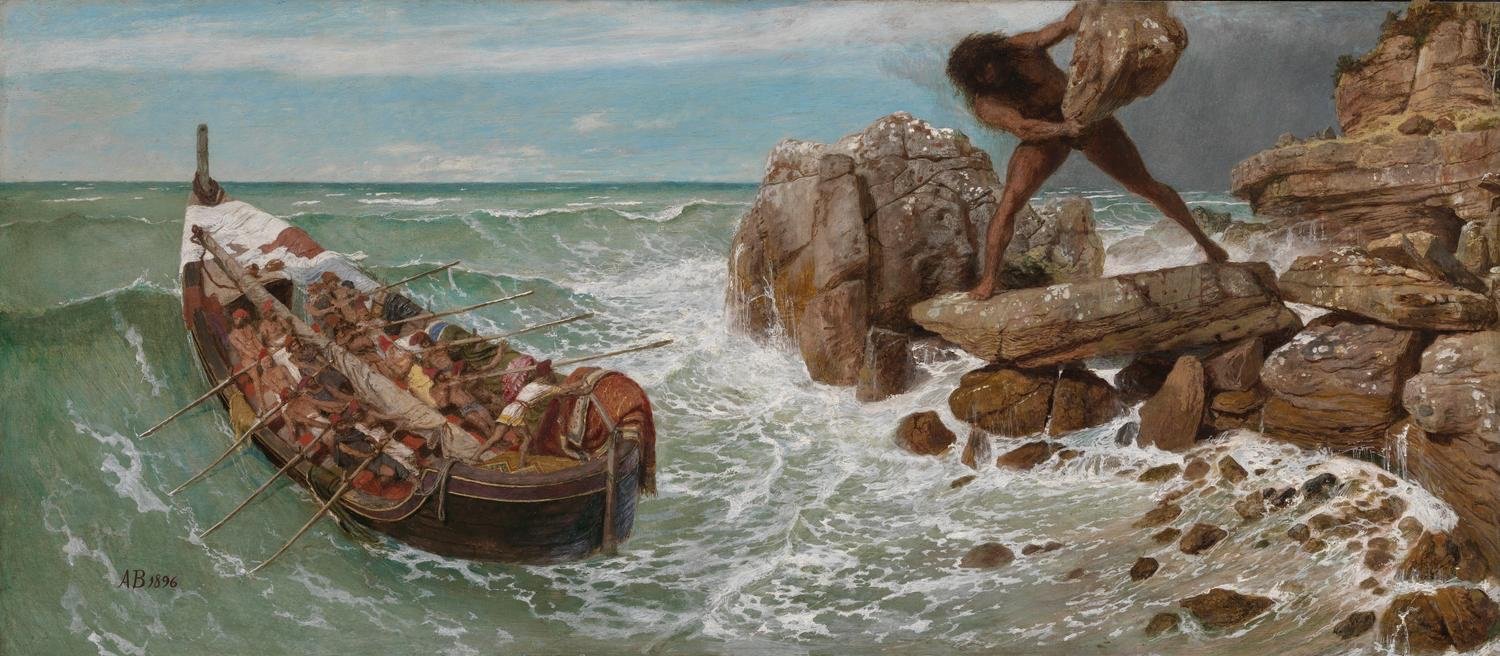
Polyphemus’s cave would then be found at the foot of Mount Erice (Odyssey IX, ll. 116-117); the Formiche islets would be nothing other than the rocks the Cyclops hurled at Ulysses; Trapani would in fact be the legendary Scheria, city of the Phaeacians; and Marettimo the true Ithaca, the one sung in the lines of the Odyssey (V, l. 381).
The lines themselves seem to speak of these lands. In Book XXII, when Ulysses slaughters the Suitors, Homer compares them to fish: “…like tuna that fishermen, in a curved bay, haul ashore with their net of a thousand holes and throw onto the beach in heaps…”
A scene rooted in Mediterranean prehistory: the drawings in the Grotta del Genovese on Levanzo (6000 BC) already bear witness to this practice, carving into the rock the memory of a gesture that has no trace at all in the Greek islands. That is why more and more scholars and enthusiasts are convinced that the Odyssey truly breathes among the rocks and seas of Favignana, Levanzo and Marettimo.
Butler put forward another revolutionary idea: the Odyssey would have been written not by a man but by a woman - perhaps a princess from Trapani, hiding behind the figure of Nausicaa. The “first novel of antiquity” would thus have been born in Sicily, written by a female voice, and would tell not of a voyage around the Aegean but of a journey around our island.
A hypothesis that, whether true or not, shows how the Odyssey is not a static text: it takes root in places, lets itself be reinterpreted, comes back to speak to different eras.
It is this continuity that makes the myth irresistible.