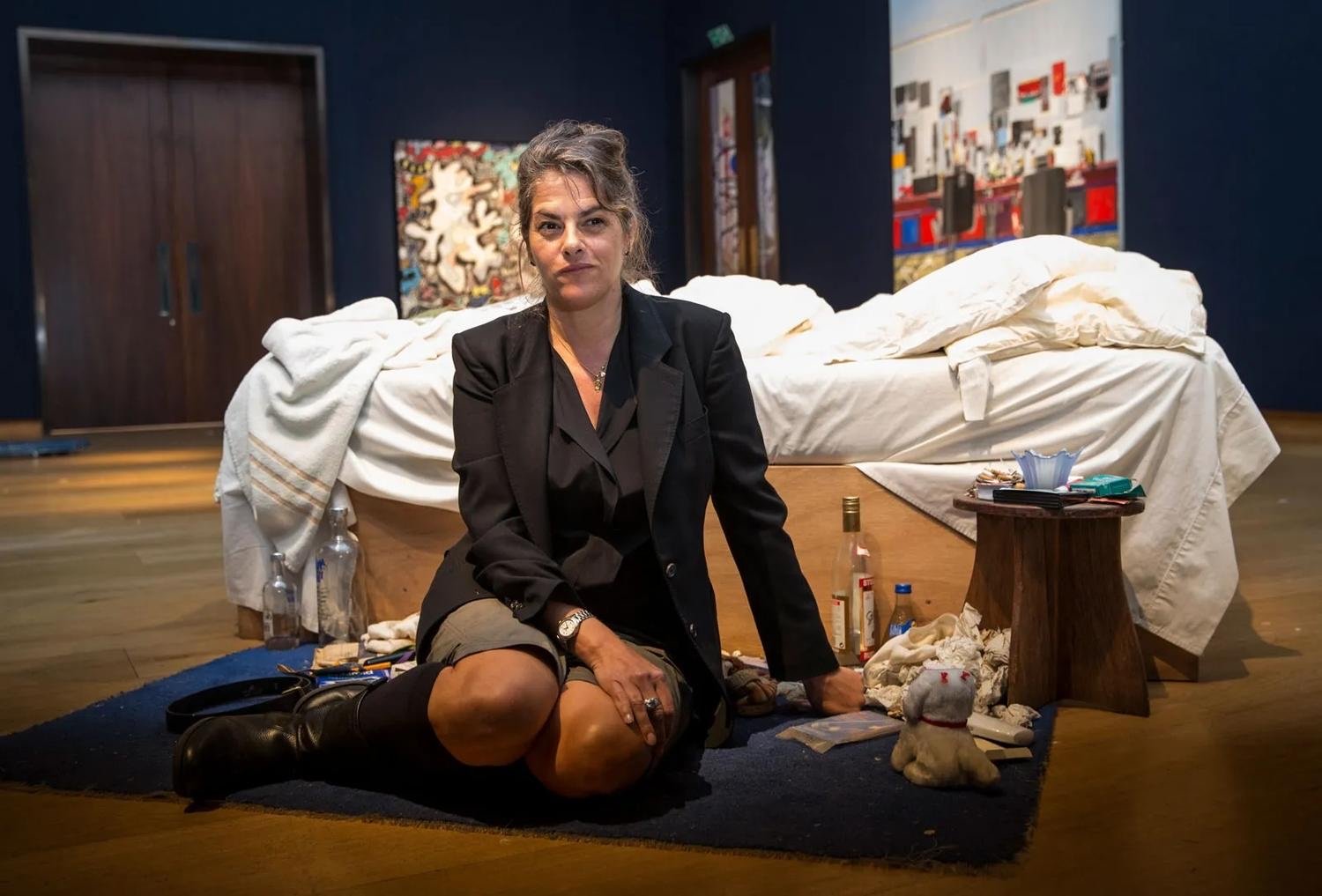
Can a bed become a work of art?
By Alice Pettorazzi
Listen
Performance:
/pəˈfɔːməns/ n. [from (to) perform “to carry out, execute”, from Old French parfornir “to complete”, related to Late Latin performare “to give form”] - 1. In a general sense, the concrete carrying out of an activity, a behaviour, a given situation.
In contemporary society, from our first years at primary school, we are treated as performers. Our results are constantly assessed: school enjoys analysing our so-called “hidden skills”, on the pretext of uncovering each person’s innate talent. And so we grow up with the idea that we must aspire to become someone, to justify our existence in the world through the things we do. We learn early on to work on our “form”, to sketch out a possible identity through clothes, haircuts, make-up, phones - a sort of “justification for existing”, a cry announcing our presence in the visible world. As a result, like little adding machines, we produce without rest: we find a job, travel far and wide, choose friends, lovers, a home, try to build meaning into our lives, or rather to make the “performance” valid. To what end?
Everyone I Have Ever Slept With 1963–1995, also known as The Tent, was one of the most significant works in Tracey Emin’s career. Conceived in 1995, it is a camping tent on which the artist sewed, in felt letters, the names of everyone with whom she had “shared her bed”. If you know Emin’s work, at first glance you might think the piece was meant to denounce the sexual abuse she herself suffered in her life; look more closely and you realise that the names on the tent do not belong only to the people she had sex with: it lists everyone with whom she shared one specific, precise place - her bed.
One-night lovers, friends, boyfriends and more: among the names is that of her grandmother, with whom she used to listen to the radio before falling asleep, and those of the two foetuses she chose to abort. A mix of love, care and memory that culminates in the phrase on the floor, addressed to herself: “With myself, always myself, never forgetting”.
The final result? A layered work, steeped in meaning and emotion. To the eye it recalls a children’s game or an adventurous night camping. The materials are easy to find; the tent and the felt suggest a shared dimension. Through the simplicity of this piece, Emin managed to explore complex themes that words can hardly exhaust.
Years of life enclosed in four walls. A refuge from the outside world.
The tent was destroyed in 2004, in a fire at the Charles Saatchi warehouse where it was kept. The artist decided not to remake it, declaring: “You can destroy the object, but you can’t destroy the idea”. These words reaffirm the conceptual strength of the work, making its absence even more meaningful. The work cannot be reproduced because it is the product of a moment, of an idea and of the person who created it.
Tracey Emin let us see, and let herself be seen.
In today’s world, letting yourself be seen is a brave and honest act. In a complicated, many-sided society that seems to have shaken off the dogmas of the past but still lives by them through new forms of control, showing yourself has become a daily necessity, a gesture of survival against being overwhelmed.
Every morning someone wakes up and has breakfast with the carousel of Instagram stories. They pick a photo from their camera roll, post it to their stories and at the same time scroll through 800 posts about exclusive events in their city, imagining being somewhere else - who knows, somewhere exotic - with the aim of detoxing from their phone (the very object onto which they are pouring all their frustration).
If you look at the etymology of the Italian verb mostrare, “to show”, as given by the Treccani dictionary, you discover that it comes from the Latin monstrare, itself linked to monstrum: it means “to make visible, to present to others so that they may observe, examine, judge”. The verb therefore implies a direct relationship with an audience, with an outside gaze that looks and evaluates. An exhibition - in Italian, a mostra - is ultimately just that: something conceived and built to be seen.
In Tracey Emin’s case, however, “putting on show” takes on a more complex and ambiguous meaning. It is not only about exhibiting: rather, it is a gesture that brushes against another, that of letting yourself be seen. Two seemingly similar concepts that are in fact very different. Showing yourself is a voluntary, conscious act, often filtered and prepared for others’ eyes. Letting yourself be seen, on the other hand, is a form of openness, of vulnerability: it means accepting that someone else may enter an intimate space, with no mediation.
Tracey Emin’s tent is powerful precisely because it lives in this ambiguity. It is an object on display, an idea conceived for an exhibition, but at the same time an intimate, private, almost secret space. The artist knows she has an audience, yet she lets herself be traversed. She shows and shows herself, but in doing so she lets her fragilities show through, as if allowing us to peek into her bedroom.
She is not physically present, but her presence is felt everywhere: it is sewn into the names, into the object, into memory. And even when the object is destroyed, the idea behind it remains intact and keeps speaking to us. That is what makes the work unique: its strength lies not only in the material but in the emotional tension that produced it.
Egocentrism? Perhaps. But it is precisely by putting herself at the centre that Emin manages to touch something universal. She becomes a filter for her own experiences, building a self-portrait made of fragments, names, absences. And in this very synthesis we also recognise a part of ourselves.
With a simple, visually light gesture - a colourful camping tent - Emin made a revolution. She shared physical, emotional and remembered intimacy, breaking down every barrier between art and life, between what we show and what we are.
In 1979, Sophie Calle created the series Les Dormeurs. “J’ai donc demandé aux gens de se succéder toutes les huit heures pendant huit jours” (“So I asked people to take turns every eight hours for eight days”), the artist recounts: for a week, strangers took turns in her bed, sleeping for a few hours, while she documented the experience by taking a photograph every hour.
In this work too, the place becomes an essential key to reading it. The bed is a private space that opens to the outside; from intimate it becomes shared. It evokes a passage, a silent ritual, a gesture of trust and surrender.
Calle, in her own way, let herself be seen. But with a different approach from Tracey Emin’s. While Emin chooses to put herself at the centre, building an emotional diary in which her identity intertwines with that of others, Calle takes the position of the silent witness. She never appears in the photographs, yet her presence is extremely strong: it is held in the bed itself, which bears the traces of her body and her everyday life.
She does not expose herself directly, but lets us into her intimacy through details, the presence of others, the passing of time. She reveals herself by becoming a spectator of her own life, gathering fragments of a personal narrative without ever openly declaring herself.
For this reason, both Les Dormeurs and Everyone I Have Ever Slept With can be read as emotional, autobiographical archives. In both works the artist is present, but never explicitly. It is a full absence, one you can feel. A self-representation that does not pass through the image but through atmosphere, memory and the radical choice to share an intimate place with someone else’s gaze.
But why is the bed so central to the discussion? Because it is the place of sleep, and sleep is one of the primary human needs. It is the space where we let go, where we dream, love, cry. An everyday refuge, yet a powerfully symbolic one.
Both Tracey Emin and Sophie Calle choose it as a focal point for taking the self apart, challenging the idea of identity as something stable, coherent, closed. In their works the self is fluid: actor and spectator at once. It is crossed by others. In Emin, a hundred names tell the story of a single person. In Calle, one body follows another in the same bed, as in a silent ritual.
It is an invitation to identify, to open up to empathy. A reminder that we are not islands.
The philosopher John Berger, in his book And Our Faces, My Heart, Brief as Photos, writes: “The number of lives that enter our own is incalculable.”
And he leaves that sentence alone, in the middle of a blank page. Nothing else. As if to say that every encounter changes us, that we are an archive of presences, a collection of traces left by others. And that, for this very reason, our identity is always in the making.
But this feeling of being one, no one and a hundred thousand unsettles us. Perhaps that is why we try to hold on to everything: experiences, faces, moments. We are afraid that one day everything will vanish. And so we accumulate, as if trying to build an archive of the self. An attempt, perhaps, to give substance to what ultimately escapes us, what wrings us out while we, exhausted, want nothing more than a little calm.
And so we come back to the bed.
The poet Jacques Prévert, in the poem “Alicante”, describes it with extraordinary delicacy:
Une orange sur la table
Ta robe sur le tapis
Et toi dans mon lit
Doux présent du présent
Fraîcheur de la nuit
Chaleur de ma vie.
(An orange on the table / Your dress on the rug / And you in my bed / Sweet present of the present / Coolness of the night / Warmth of my life.)
A simple scene, perhaps a little too sentimental; and yet “doux présent du présent”, the sweet present of the present, holds a hymn to life, to the tangible presence of the other, to the strength of small gestures. The last lines, the “coolness of the night” and the “warmth of my life”, close the poem by restating an urgency: an authentic, deeply human contact.
In a time ruled by speed, by performance and by dating apps that turn intimacy into mechanical scrolling, the bed can be a revolutionary element, a concrete place where, perhaps, we can begin again.