Music ·
Festivals as a new kind of “Third Place”
By Olga Bykova
Listen
The concept of the “Third Place”, coined by Ray Oldenburg in 1989, defined the space between home (the first place) and work (the second).
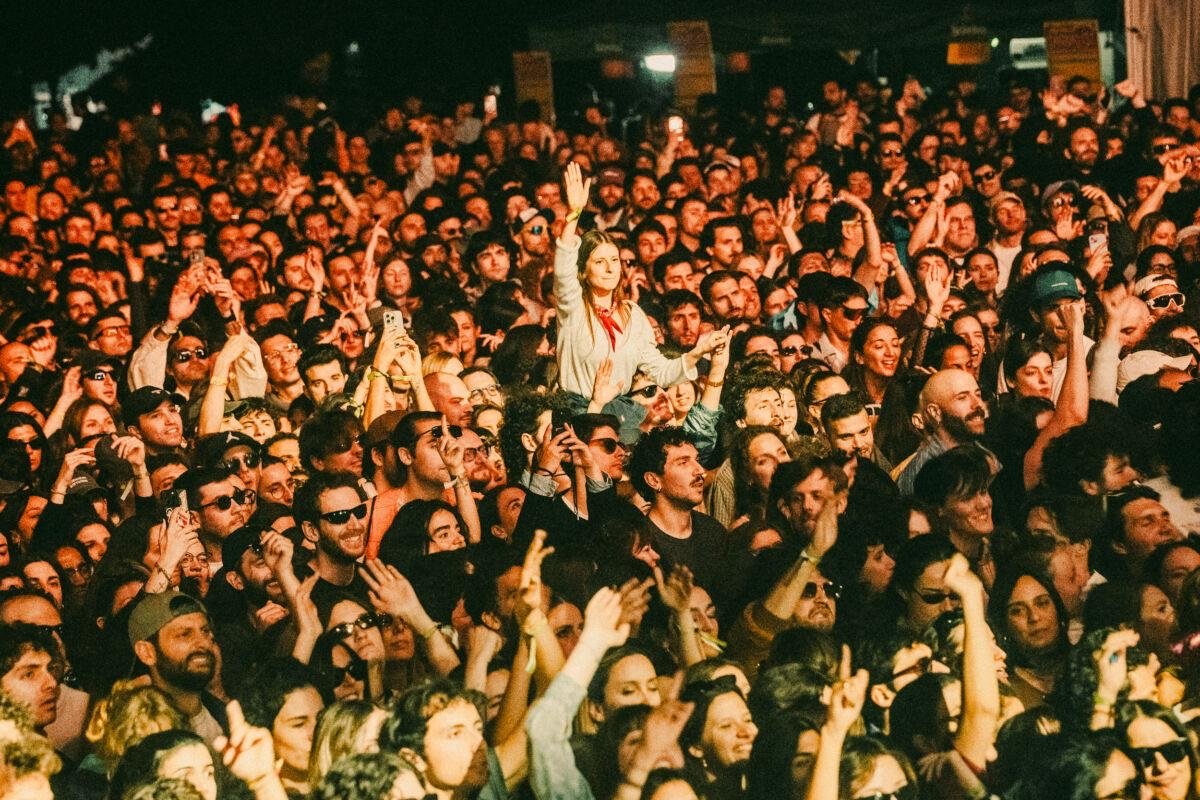
But today work begins in bed, carries on at the kitchen table, ends somewhere between a voice note and a Pilates class, and in the evening perhaps at a music festival, where the place exists only as long as the people inhabiting it do. The feeling is that it is getting harder and harder to say where things actually happen, and this blurring of boundaries is becoming impossible to ignore.
The “classic” Third Place is not dead, but it is not easy to define either, and the question that arises is whether we need to rethink it differently. Perhaps no longer as a clearly defined geographical location, but as a temporary state. As a “Fluid Place”.
If life in the city is changing, buildings have to change too. And they are. Alongside vertical villages, farm-cities, biodiversity towers, “flip-flop” houses or moving walls in micro-apartments, a lot is happening around multifunctional space.
In Detail Magazine, Reinier de Graaf (Partner at OMA, the Office for Metropolitan Architecture, the renowned international practice founded by Rem Koolhaas) describes architecture not as a finished object but as a support structure that can be endlessly reprogrammed. The more variable the intended use, the more neutral and robust the structure must be. What matters is not the functional programme itself but its organisation: which overlaps are possible, and which are necessary?
“Only radically flexible, infrastructure-like buildings can cope with every single change of function.”
For this very reason, de Graaf argues for design approaches that treat change not as an interruption but as an integral part of the concept. It is paradoxical, but he says: “Buildings become more sustainable when they allow for easy dismantling”.
This approach can also be read in theoretical terms. Instead of understanding space as a hierarchical system with fixed centres, we can conceive it as a network. A Fluid Place following the logic shaped by Gilles Deleuze and Félix Guattari’s rhizomatic thinking: “with no clear beginning, no definitive end, no central control.”
Mixed use is a direct response to this situation. Today people want short distances and a better merging of life and work, so-called work-life blending. And so a park becomes a festival for a weekend: an existing place is turned into social infrastructure, created by whoever shows up. As a result, more and more mixed-use concepts are emerging.
However, when we talk about mixed use we are not talking about a simple coffee corner. A coffee corner in your industrial-style shop will not draw people in, nor is it an evolution towards a third place. The real point is understanding how these places can blend. What if their purpose were truly fluid, with unexpected typological intersections? A space whose identity changes completely depending on the time of day, the people and the programme involved.
What about the time before and after opening hours? Are there spaces we could use differently? For example: a nursery in the morning, a retail space during the day and a festival in the evening, where the “X” in between becomes crucial not just as a change of function, but as a condition in which a space brings people together and keeps redefining itself.
Central to all this is the role of people. Participation and co-creation could make it possible not only to use spaces, but to actively shape them, led by the community. The simple act of being physically there, sharing a temporary physical presence with others, itself becomes a form of architecture.
Breaking rigid categories and watching the most unexpected encounters happen in places where we would never expect them: it is exactly in the unexpected intersection, in the breaking of rigid categories, that things become truly exciting and sustainable. The future of space is not designed in zoning plans; it is inhabited like a festival: an infrastructure for encounter, in constant, fluid transformation.