Music ·
Charli XCX: Staying “too long” in the music scene
By Davide Merola
Listen
Charli XCX sometimes films herself on her TikTok as if she were on FaceTime chatting to her friends. She is messy, provocative and eager to share: that is what Brat is. A record that changed everyday (normal) language, bringing an unhypocritical kind of “sharing” into the music industry. As Charli wrote on her finsta @360_brat on the anniversary of the album’s release, Brat was made with “pure passion and zero sacrifices” and is therefore destined to last. In May - again in what look like video calls - Charli XCX admitted she felt sad, as if celebrating the anniversary of Brat a few months later meant the end of its life-and-culture cycle: “It’s really hard to let go of this thing that’s so intrinsically mine and that became my whole life”, she says in the video. But then she admits she is interested in the idea of staying too long (“the tension of staying too long”, she says). Not something many artists would say out loud. What does “staying too long” actually mean, and where does that desire come from?
Nobody expected Brat Summer, and watching it happen before our eyes was certainly a cultural and media event of some weight (no surprise, on the other hand, that Charli deserved a moment like this, which she had been preparing for at least ten years). Probably the last time an album had such an impact on the industry, enough to stick around “for long” (as far as I can remember), was Daft Punk’s Random Access Memories: other icons who, with that record (at the time we did not yet know it would be the end of the de Homem-Christo/Bangalter duo), were continuing their years-long reappropriation of an old negative review that had dismissed their earlier band Darlin’ as “a daft punky thrash”. Is it, then, first of all a question of language? Who knows whether Charli XCX and Thomas Bangalter were talking about exactly this when they sat next to each other at an event in Cannes, because Brat too is the reappropriation of a word poised between two meanings: one that describes a badly behaved, annoying child, and one that describes a person with a confident, independent attitude.
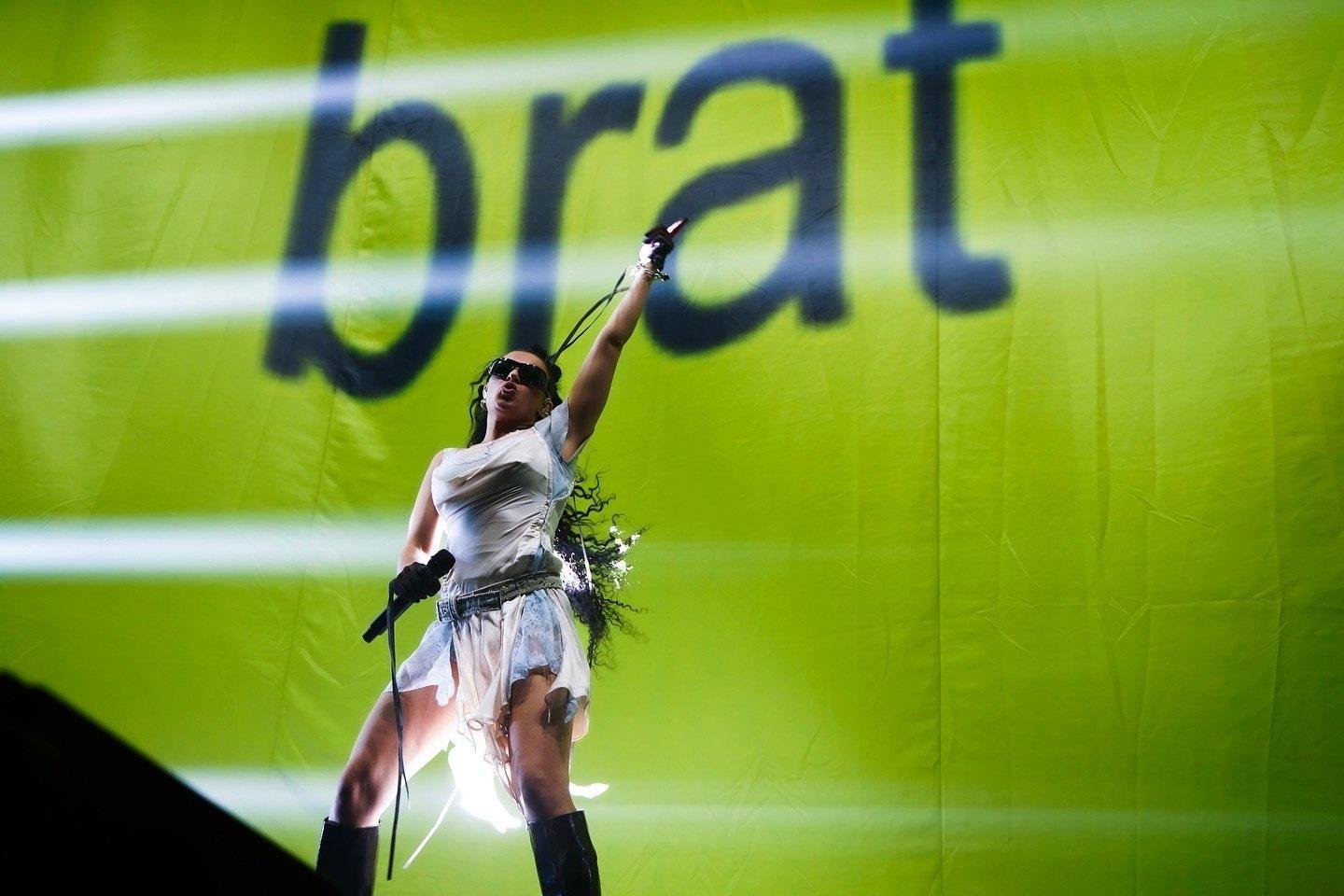
For more than ten years Charli was poised too. Then the iconic green cover (now “Brat green”) started dropping down at the back of her stages, breaking that balance and channelling everything into the single meaning of someone confident, bold, independent and unafraid to express herself. With a messy, rebellious kind of representation, Charli XCX used this (hyper)normal language to try to break down the barrier between artist and audience, challenging the idea that it’s lonely at the top. And so she brings her friends on stage, from drummer-producer-husband George to The Dare and A.G. Cook (the other key members of team Brat), all the way to it-girls Gabriette, Alex Consani and Julia Fox. Among them Charli barely stands out: she is in the crowd partying with the audience as if they were all there for the same reason. When Brat wins three Grammys she says into the microphone “we won”. There is no “I” - and that is no accident.
Brat arrived at a moment when people wanted new music, when interest in the rebirth of club culture was at its peak and audiences wanted idiosyncrasy from pop stars. In short, people were ready for Brat and for Charli as never before. She, for her part, was very strategic: from the private account to her PARTYGIRL Boiler Room in New York last March, she created a new sense of FOMO and took it to another level. How? By talking honestly about relationships, embarrassment, motherhood and how hard friendships can be. And with all the expectations placed on women (especially in the music industry), which of them would not want to be brat?
Watch any video shot at one of Charli’s recent shows and you will surely find a caption along the lines of “how do you explain this feeling to men?”. Irony aside, the question is legitimate and seals her role as an LGBTQ+ icon: a milestone that goes back to 2016, after working with the trans producer Sophie on the Vroom Vroom EP, her first venture into avant-pop and one of the first iterations of hyperpop to reach a mainstream audience (which, together with the album made during the pandemic, how i’m feeling now, would pave the way for Brat). The gays get it, as they say online. But online they seem to wilfully ignore that Brat is an album that speaks to everyone. It speaks with women but above all about women, to men: inevitable in a record that drops pop metaphors without caring about the consequences. Charli fights - even over trivial things - but makes up just as easily when she realises that to dismantle the structures that brought her to that point, all it takes is talking (with Lorde in Girl, so confusing). Charli feels embarrassed, but she cannot help needing validation from others, especially when she finds herself competing with other women: those are her words in sympathy is a knife, where she also addresses her husband George, who embodies something of the category that pushed her towards this desperate need to feel validated. Obviously it is not George’s fault as such, but it is also his fault. It is our fault. And in the end he is the same person who seems not to notice anything: “he’s so naive”, Charli sings. There is room to reflect on motherhood too in I think about it all the time, where Charli shares her uncertainty and doubts about when, or whether, to take that step in her life. The track lands like an introspective bomb in Brat’s tracklist, but in hindsight it is not even a surprise. In it (probably still addressing George) she says: “So, we had a conversation on the way home / Should I stop my birth control? / ’Cause my career feels so small / In the existential scheme of it all”. It is a serious contemplation of an equally serious life choice, on a par with her interest in “staying too long”. The other side of the coin. We could go on dissecting her lyrical genius (as she herself likes to joke) in Brat, but the point is clear: Charli observes the female and the male world together. While staying on the margins, she actively shapes the themes of both. Perhaps that is really what made Brat, brat.
And although during her tour Charli tried to ruin the iconic green curtain that drops before she comes on stage (finally burning it at Glastonbury), the end of the Brat era is far off. The unlikely Taylor Swift brought it back to life: with the release of her latest album, The Life Of A Showgirl, she opened the door to a crisp Brat Autumn. It all starts from the Brat themes we have already mentioned: from looking for some sincere friendship in an industry that would like to pit girls against each other, to the most visceral version of that theme in sympathy is a knife. When the album came out, Charli was keen to clarify that there were no diss tracks on it: the songs in question, she explained, were rather about the complexity of being a woman in the music industry, constantly compared with your peers and at the same time expected to be friends with everyone. If you were not, you were easily labelled a “bad feminist”. According to Charli, it is an unrealistic expectation: some days you feel on a pedestal, others vulnerable, insecure or even competitive. Emotions that are hard to deal with in an environment where people would rather not talk about them. That is exactly why those songs become a way to break the silence. But, as we know, the internet does not forgive. And it had decided that sympathy is a knife was about Taylor Swift. The theory drew strength from the gossip that Taylor had for a while been seeing Matty Healy, frontman of The 1975 (a situationship she herself recounted on her previous album, The Tortured Poets Department). Another member of the band is drummer George Daniel, now Charli’s husband. In the song Charli sings of an irrational feeling of jealousy, but not of envy; of discomfort rather than hatred. She sings of a sharp emotion that brought her within a step of hurting herself. Taylor Swift is not its cause, and Charli never considered her so. But then Taylor Swift releases Actually Romantic (whose title already parodies Brat’s everything is romantic), which opens like this: “I heard you call me “Boring Barbie” when the coke’s got you brave / High-fived my ex and then you said you’re glad he ghosted me / Wrote me a song saying it makes you sick to see my face / Some people might be offended”. The childish, almost bullying language falls right into the very point Charli was singing about, and manages to tell us nothing (nor does it seem to want to) about wider, social themes. It is simply a diss in reply to a song that was not one.
What makes the alleged tension between Charli and Taylor compelling is how each artist mirrors the other’s approach to fame and storytelling. Both write about image, control and vulnerability. Both play with their public persona. Their supposed exchange might be pure coincidence, or it might be two artists writing about the same cultural system from different perspectives. Certainly distant ones.
That is exactly what Brat is about. And it will probably let us keep adding new readings to this context for a long time, if not forever. Because, as the captions that close Charli XCX’s sets put it: “I want this to last forever / It wasn’t just a summer thing… / It’s a forever thing / Please don’t let it be over”.