Lina Bo Bardi, when an artist crosses a cultural frontier
By Melissa Zangrandi
Listen
What happens when an artist crosses a cultural frontier? Is it possible to cross a cultural frontier without turning the other into an object of one’s own gaze?
In contemporary Europe, multiculturalism is an everyday reality. Every day we come into contact with traditions, languages and ways of life from realities foreign to us, with which we often relate passively. The cultures we meet rarely appear to us as living organisms with their own history and complexity. More often they end up as simplified images built through our judging gaze: they become mannequins moulded in our own image and likeness when they reassure us, or they take on animal or monstrous traits when we perceive their otherness.
The risk we run through exposure to this “passive multiculturalism” is erasing cultural entities and replacing them with a fictitious representation, distorted by our interpretation of them. What we observe is inevitably filtered by the cultural categories we already have and, without realising it, we end up interpreting the other according to subjective parameters. It is in this space that a subtle form of cultural imperialism can creep in: made not only of impositions, but also of interpretations that end up drowning out the voice of those we observe, to the point of replacing an identity with a colonialist imitation of it.
“The experience of time, understood as the present, is what is still alive. And it is this present that keeps us from falling into the trap of the future. Our task is to build another present, a ‘true’ present. To do so, we must understand the past historically and be able to recognise what, in it, can still serve the new situations the present puts before us.”
This reflection, so relevant today, is what the artist and architect Lina Bo Bardi taught students at the São Paulo school of architecture a few years before her death. Her path shows how crossing a cultural frontier can mean neither erasing the other nor representing them through one’s own gaze, but letting oneself be transformed by them, acting in a space of respect and cultural sharing. A vision with an important affinity to the concept of anthropophagy theorised by Oswald de Andrade, according to which European culture should be neither imitated nor rejected, but “devoured”, transformed and mixed with local traditions to create something new. It is precisely this openness to change that forms the foundation of her research and her way of understanding art, architecture and culture.
Lina grew up and studied in a painful period, in an Italy exhausted and scarred by the destruction of war. Born in Rome in 1914, she studied architecture and completed her degree with a thesis project titled “Maternity and Childhood Care Centre”. Her collaborations with leading figures of Italian culture, such as Gio Ponti and Carlo Pagani, took her to Milan, where she worked as an architect in the studio she founded with Pagani; she also wrote for several major magazines, including Grazia, L’Illustrazione Italiana and Lo Stile. Lina’s was the voice of a multidisciplinary artist: she devoted herself not only to architecture and writing but to many artistic and design practices, including drawing, painting, design and interior design. Later she would also turn to craft and to designing jewellery, clothes and everyday objects.
When Lina married the journalist and collector Pietro Maria Bardi, their life changed radically. The couple set off on a journey to Brazil that involved their professional and personal outlooks, their dreams and their needs, which a war-torn Milan could no longer satisfy. Pietro received an offer from the entrepreneur Chateaubriand to direct the São Paulo museum. The couple moved to Brazil in 1947.
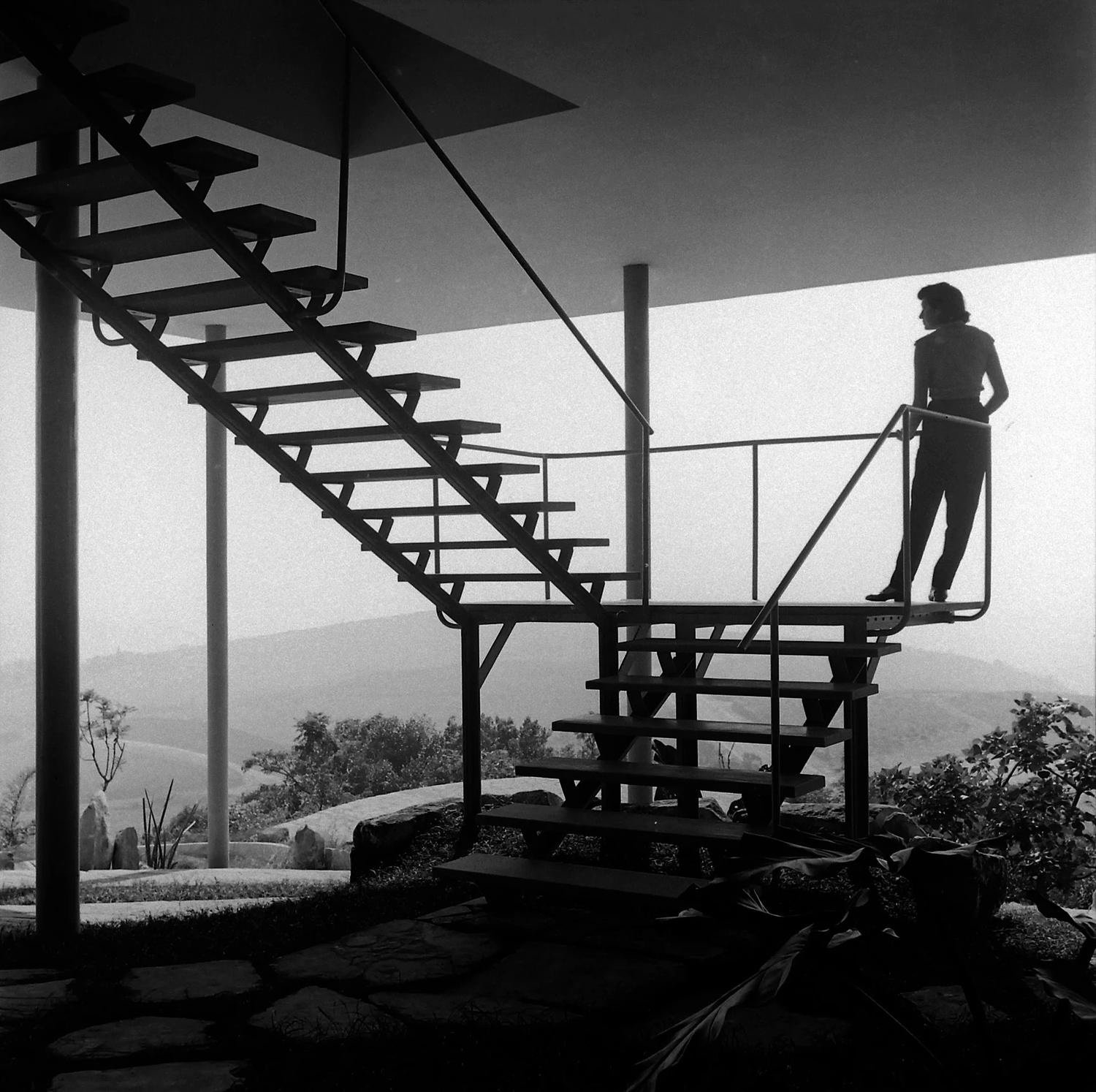
In 1951 Lina built her most personal project: the Glass House, a modernist work that would be her home until her death in 1992. From that moment on her life intertwined with the country’s cultural heritage, in a bond of admiration and respect for its artistic practices that would never be broken. Engaging with Tupi, Afro-Brazilian and vernacular culture, without a folkloristic or nostalgic approach, became the defining accent of Lina’s research: recognising forms of knowledge that modernity and colonialism had pushed to the margins, and giving them an active role in her contemporary vision.
For Lina, the encounter with Brazilian culture, and in particular with popular, indigenous and vernacular traditions, was not mere ethnographic interest. It became the starting point for a radical reflection on the meaning of culture, the social function of architecture and the relationship between art and everyday life. This perspective resonates with what Guy Debord called the separation between culture and life. If in contemporary society culture risks turning into an autonomous sphere, removed from everyday experience, Lina Bo Bardi championed the dream of a collective artistic plurality. Art, architecture and design become once again tools of community life, places of encounter and participation, rather than objects to contemplate: a cultural struggle against the erasure of artistic space that separates art from its audience.
Lina Bo Bardi’s works are designed to be lived in before they are looked at. Their strength lies not in the image they project but in the relationships they can generate. Architecture becomes a place of encounter, play, work, education and exchange. In this sense her work embodies an idea of art without frontiers: an art that does not separate the museum from the city, the work from everyday life, popular culture from high culture.
Breaking down frontiers is the key to all her projects: from the restoration of the Solar do Unhão, a group of abandoned historic buildings turned into the new home of the Museum of Modern Art of Bahia, to the São Paulo Museum of Art, inspired by the communal power of the Greek agora and a cornerstone of what would later be called Paulista architecture, culminating in SESC Pompéia in São Paulo. In 1977, when she was asked to restore a disused metal factory in the city, she found herself facing the social reality of the building, which every day hosted the neighbourhood’s residents in the intimacy of their social space.
Lina therefore decided to change the original project so as not to upset the nature of the community space, turning it into a small oasis where children could keep playing football and neighbours could meet to chat. The lower part of the concrete building, then unusable because of underground water seepage, was rebuilt as a watercourse recalling a river, respecting not only the social nature of the place but that of the land as well. SESC was officially inaugurated in 1986, but the space came alive years earlier when, while work was still under way, it hosted a punk music festival and became a cultural landmark for the movement.
Today SESC Pompéia is considered one of the most radical and important architectural works of the twentieth century.
And it is perhaps in this last project, more than in any of Lina’s other urban interventions, that we find the answer to our questions, through an almost utopian vision of frontiers broken down. Lina moves through the space she works on like an all-knowing soul; nature, people and history seem to speak to her and suggest she create open spaces where every being can feel at home.
That is how Lina described her São Paulo experience to her friend, the architect Bruno Zevi, almost as if to say, metaphorically, that she had accepted a mission of love towards a country that had welcomed her with open arms and with which she had fallen so deeply in love. Having finally found the place to devote herself to entirely, Lina Bo Bardi devours Brazil and invites her new community to a feast of cultures and traditions that will never be lost or forgotten.