Film ·
23,000 Lives and the right to be more than your tragedy
By Martina Fettolini
Listen
The visual repertoire we instinctively draw on when we talk about migration is made of scenes now rooted in our imagination: overcrowded dinghies, life jackets, exhausted bodies wrapped in golden thermal blankets.
The need for images like these has been undeniable. They played a fundamental role in making visible a tragedy that would otherwise have stayed on the edges of the European and global gaze. But if it is true that ten years ago pain mobilised public opinion, generating empathy and outrage, today we have all grown numb to the horror of others. Every language, once it hardens, inevitably creates a blind spot and ends up eclipsing people’s lives, as if the tragedy exhausted their identity.
On 17 July a story arrives on Netflix that, in some way, steps out of that shadow. It is the film 23,000 Lives, inspired by the true story of the Iuventa, a ship bought through a crowdfunding campaign by a group of young Germans from the NGO Jugend Rettet who, with no experience of rescue at sea, decided to patrol the Mediterranean migration routes, helping to save more than 23,000
people.
But beyond the dramatised reconstruction, it is Michele Cinque’s original documentary - also on Netflix from 26 July - that is the heart of this project. The documentary shows the effort, now ten years long, to finally shift the focus of the story: it no longer just bears witness to the horror of the routes, but tackles questions of law, politics, rescue at sea and the criminalisation
of solidarity. At the heart of it all, though, remains the story of human beings.
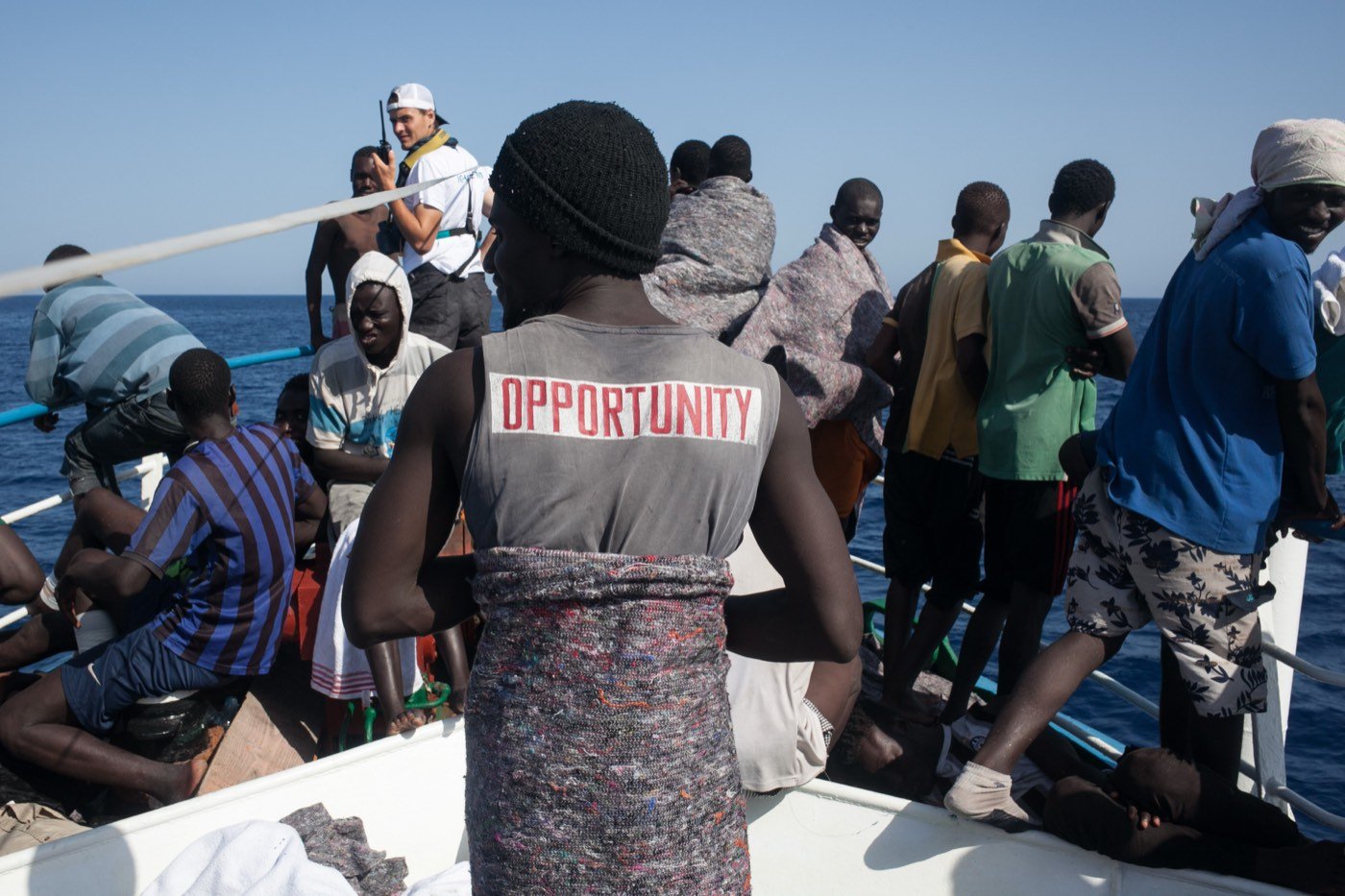
It is the same gaze that emerges from César Dezfuli’s photographs, taken during the Iuventa’s first mission in 2016. There are young men and women smiling at the lens, pointing at the camera with the enthusiasm of people who want to be seen.
These are details with the power to change the point of view of the story, making us realise that these people are not made of their tragedy. None of us would want to be told exclusively through the worst moment of our life. And yet that is what constantly happens in the representation of migration.
In this sense, the work of Michele Cinque, César Dezfuli and the whole crew of the Iuventa and Jugend Rettet becomes something deeply necessary - framing the situation in a way that reminds us that behind every photograph of a rescue there is a person who still has a story, a character, passions and a possible future.
Because no tragedy should become the only way we choose to look at a human being.