Can you catch a cloud?
By Sara Innocenti
Listen
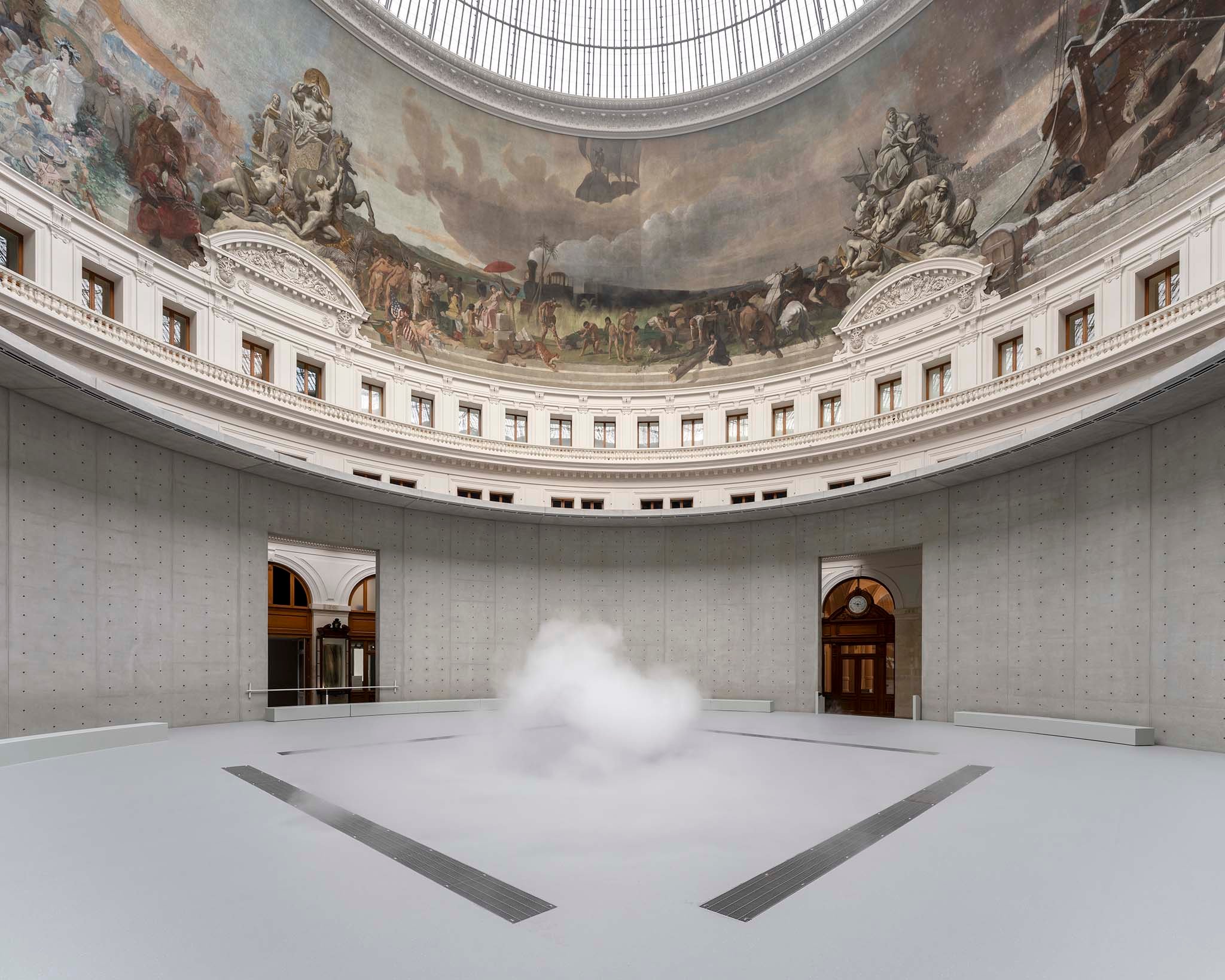
This summer, in Paris, there was a cloud in a room. Seeing it there, far from its sky, stirred a childhood wish: to catch clouds. At last anyone could get close enough to find out how soft they were or, more likely, how wet. All this is the work of Fujiko Nakaya, a Japanese artist who sculpts clouds and uses them to redraw the boundaries of how we see the world.
After studying in Tokyo, the United States and Paris, in the 1960s she set painting aside to devote herself to producing fog on a large scale. Since the 1970s Fujiko Nakaya has been creating real fog sculptures: excesses of matter, water droplets filling the air, passing presences that come between visitors and the world. Cloud #07156 is one of them.
The work was part of the exhibition “Clair-obscur”, curated by Emma Lavigne, chief executive of the Pinault Collection, with the art historian Anne-Marie Duguet. Until mid-September the cloud invaded La Rotonde, the huge frescoed hall at the heart of the Bourse de Commerce, letting visitors walk through it as it grew, shifted and swelled, fed again and again by a high-pressure misting system with varying directions and intensities. An opaque presence, inevitably in the way, that kept people from seeing their surroundings clearly.
Once inside the hall, people walk around it before slowly, silently approaching. They seem to adapt to its rhythm, or perhaps they try to anticipate its unpredictable movements. Then they stretch out an arm, watch their fingers blur and turn to catch one last glance from whoever recognises them, before disappearing into the fog. When they try to grab that thick white matter, nothing is left between their fingers.
We are used to thinking that, to see something, the space between us and what we are looking at must be empty, free of anything that might hide parts of it. That way we would be able to see everything and know how things really are, tell the true from the false, understand what is real and what is the product of our imagination. But what if the space between us and the world had never been empty?
In Japanese there is a word, ma (間), that refers precisely to the interval, the relational space between things. Cloud #07156 reveals what normally escapes our perception and makes it tangible. The anthropologist Tim Ingold has devoted much of his work to questioning the idea that an observer is separate from and independent of their surroundings. In reality we live immersed in a system of relationships, materials, flows and movements that pass through us and that we help to transform. As the exhibition catalogue puts it: “the fog materialises space itself, asserting that it is not empty”. Nakaya’s cloud suddenly makes this condition material: it reminds us that there is always something between us and the world.
“The fog responds constantly to the environment, revealing and concealing the features of the landscape. Fog makes visible things invisible and invisible things visible,” Fujiko Nakaya explains. The work interacts with elements it cannot control: air, humidity, moving bodies. “It is a conversation with the wind,” Nakaya says. Those who try to photograph it capture a very delicate transparent veil, or a creature threatening to swallow the visitors - rarely the shape of a cloud in proportion to the hall and its frescoed dome. It is a work that changes all the time, just as our gaze does. There is no stable point of view, and no privileged one either.
Anne-Marie Duguet goes further: “it is no longer a question of points of view, single or multiple, but of visibility itself”. For her, Nakaya’s fog is a real anti-panopticon. The reference is to Jeremy Bentham’s panopticon, taken up by Michel Foucault as the paradigm of a power founded on total visibility: a space designed so that every body can be observed from a single privileged point. The cloud produces the opposite effect: its intermittent transparencies stop any single gaze from dominating the scene.
Nakaya’s cloud questions the idea that seeing means fully possessing what you look at. It breaks the illusion we all share that we can know the world with certainty, once and for all. We will keep giving in to the temptation to stretch our gaze to capture what surrounds us, in search of a neutral, definitive point of view. But it is not possible - just as it is not possible to catch a cloud.