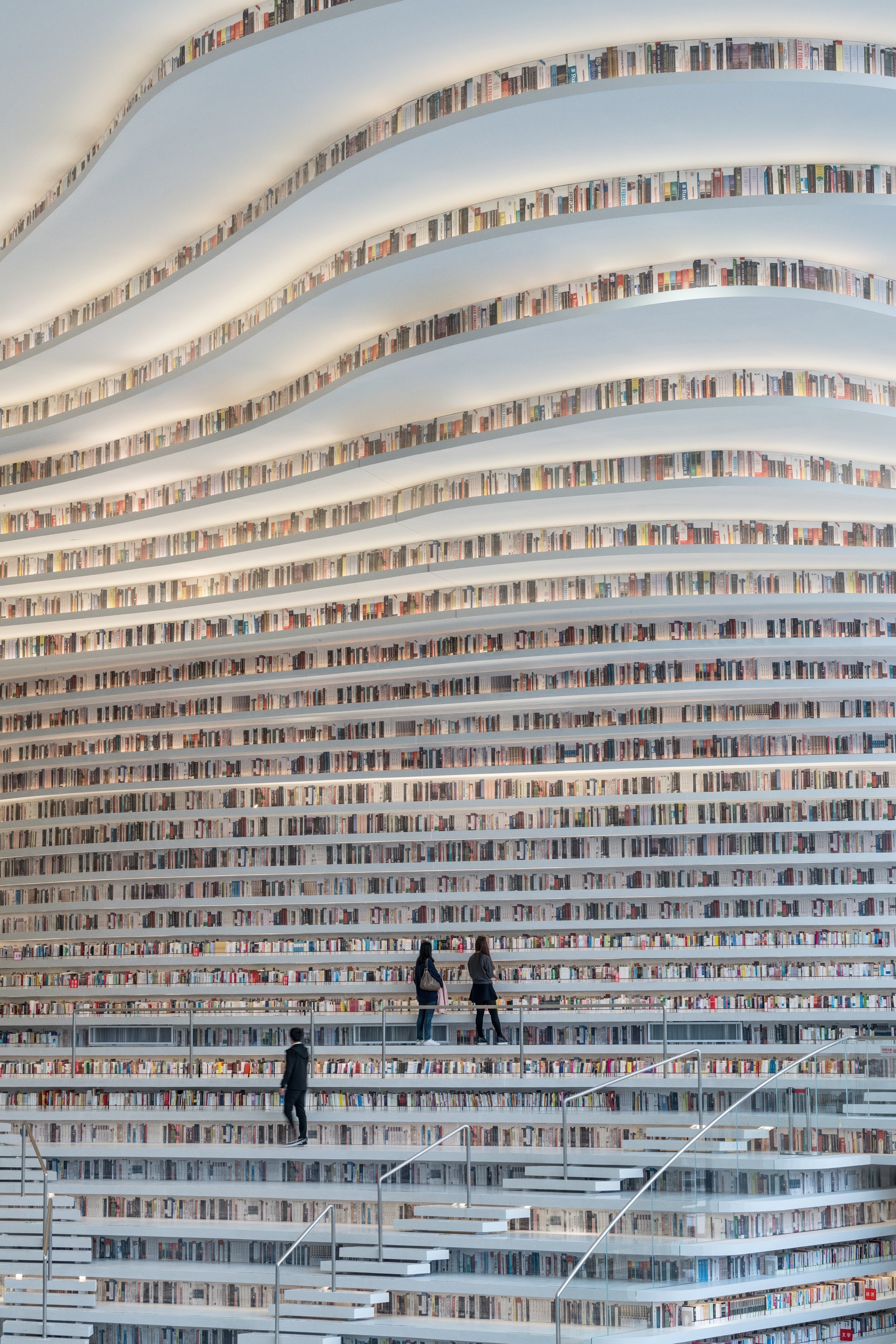
The Architecture of Thought: how knowledge has been transformed in the forms of the library
By Alice Ferretti
Listen
For centuries, knowledge was seen as the foundation of civilisation and preserving it as a sacred act. In the beginning it was temples that guarded knowledge handed down orally; over time, these places became sacred homes for scrolls and papyri, giving rise to the places we now call libraries.
The Library of Alexandria was the first great library of antiquity. Considered the dwelling place of the Muses, it aspired to gather the Arché: the original principle from which the whole of human knowledge derives.
For a long time humanity cultivated the utopia of a total, orderable knowledge. This desire took shape in attempts at universal works such as Pliny the Elder’s Naturalis historia (1st century), Vincent of Beauvais’s Speculum Maius (13th century) and Diderot and d’Alembert’s Encyclopédie (1751-1772).
The same desire shaped the Baroque libraries, with their monumental “book halls”: rooms where continuous shelves wrapped the reader in an unbroken embrace of paper, turning architectural space into a physical representation of the order of knowledge.
An echo of this ambition can still be found today in the reading room of the Cincinnati Public Library.
Later, with the Enlightenment, came the age of the Respublica litteraria, in which the book became a vehicle for scientific progress and rational order. Thanks to growing literacy and the spread of cheap books, this ideal began to reach everyone, allowing the first public libraries to emerge.
This positivist faith in the orderability of knowledge and of the world, however, shattered in the twentieth century. There came to be too many books, and too many readers; the world began to extend beyond national borders and reality no longer seemed orderable.
Rem Koolhaas’s Seattle Public Library is the manifesto of this rupture: transparent surfaces, suffused with light, but inside, shelves arranged irregularly and at an angle. This is no mistake, but an attempt to reflect a knowledge that has become “unorderable”, in which the boundaries between disciplines fade away.
The absence of a single centre has turned the sum of human knowledge into a labyrinth. To get through it, readers need to build their own path, following personal interests and associations. At Hjørring Central Library, in Denmark, this need finds symbolic expression in a red ribbon running through the library’s spaces: a modern Ariadne’s thread, designed to orient visitors and accompany them in their discovery.
Today the experience of knowledge is entirely subjective and, at the same time, guided: we are no longer scholars but prosumers, hybrid figures between producers and consumers who ingest information from the web according to a taste that seems unique but is in fact steered by the algorithm.
The physical book, once a monolith, is now an outdated alternative to faster media and, in the Nam June Paik library, it is even displayed in transparent cases, like a relic of the past.
Individual knowledge thus seems to swing between two extremes: solitude and the ephemeral. The first is reflected in the Seashore Library in China, isolated on the shore; the second in Guangzhou Public Library, disguised as a shopping centre in the urban landscape.
In this “posthuman” scenario the book is no longer the sole protagonist, and may occupy as little as thirty per cent of the space, as in Helsinki’s Oodi library.
Paradoxically, the library becomes a place that could do without books altogether. From temple of memory to infrastructure of knowledge, it turns into an open space in which human beings seek new forms of orientation and relationship.